

Three songs.
That’s it.
No second chances. No waiting until the end of the night to figure things out. No asking the artist to step back into the light and do that cool thing one more time.
For a concert photographer, three songs can be the entire show.
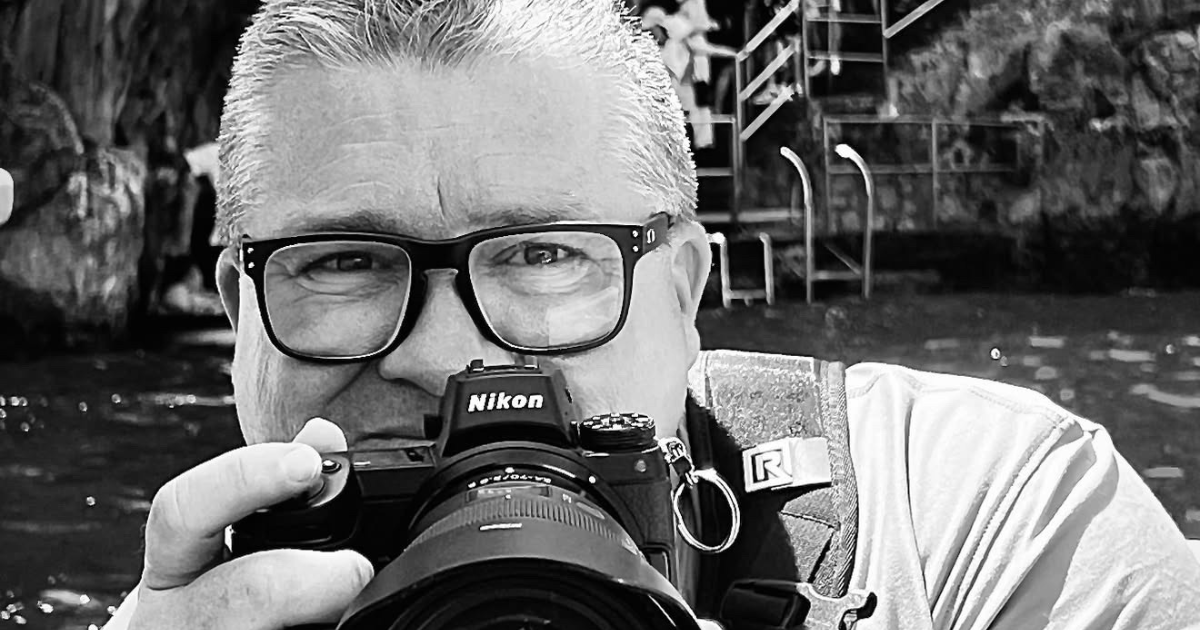
Tom Rentz wouldn’t have it any other way.
After nearly three decades photographing artists ranging from KISS and Journey to Billy Idol, Duran Duran, Blake Tyler, and countless others, Rentz still talks about standing in the photo pit like someone who just discovered it yesterday.
“It’s heaven,” he told me.
Three songs.
Then get out.
And somehow, after all these years, that’s still enough to make him drive hours for the opportunity.
Sometimes considerably more hours than intended.
The Shot Before the Shot
I first really started paying attention to Tom’s work after we photographed the same show.
That’s one of the interesting things about concert photography. Put several photographers in the same pit, give them the same three songs, the same artist, the same lighting and roughly the same angles, and you’ll still end up with completely different photographs.
Tom’s looked different than mine.
Not necessarily because he was standing somewhere I couldn’t stand or because he possessed some magical camera setting nobody had told me about.
They simply felt different.
One particular image of country artist Blake Tyler stuck with me. I had photographs of Blake performing onstage that I liked.
Tom had one that looked like Blake was emerging from the rubble after conquering a small country.
It was gritty.
Atmospheric.
Rock and roll.
And that led me to the obvious question.
How?
The answer turned out to have considerably less to do with Lightroom than I expected.
It starts before Tom presses the shutter.
Know Where They’re Going
Tom does his homework.
When possible, he’ll watch footage of an artist’s previous performances before arriving at the venue.
Because concerts, especially larger productions, aren’t completely random.
Musicians have positions.
They have habits.
They have moments.
Someone walks onto a riser during a particular song. Another musician comes down the catwalk. A guitarist hits the same pose. A performer jumps into the crowd.
Once you’ve photographed an artist multiple times, those tendencies become even easier to recognize.
That knowledge puts Tom in position before the moment happens.
It doesn’t mean he gets everything.
He doesn’t.
Nobody does.
Tom freely admits there have been plenty of times when something happened on the opposite side of the stage and he was left wondering how he missed it.
But preparation improves the odds.
He described watching one performance and noticing equipment being moved near a catwalk. A ladder appeared. Then a drum.
Something was clearly about to happen.
Rather than staying with the photographers gathered near the stage, Tom moved into position.
The performer eventually climbed onto the ladder and began playing the drum surrounded by fans as a spotlight cut across the scene.
Tom was waiting.
That’s concert photography.
Sometimes the best camera setting is simply being in the right place.
Burst Mode Is Your Friend
Once Tom sees the moment, he’s not shy about holding down the shutter.
He shoots bursts.
Why?
Because it’s digital.
Delete what you don’t need.
The philosophy is simple, but the reason behind it is important.
Live music is movement.
Facial expressions change instantly. A guitar swings through the frame. Hair moves. Lights change. Hands go up. Eyes close. Eyes open.
One frame might have everything.
The frame immediately before it might have a microphone blocking half the artist’s face.
Tom wants the moment.
If capturing several frames gives him a better chance of getting it, he’ll take them.
The editing can come later.
Show Me the Artist
For all the preparation and technical decisions behind Tom’s work, his photographic philosophy is surprisingly straightforward.
He wants to show you the artist.
Not his Photoshop skills.
Not an elaborate effect.
Not something so heavily manipulated that the photograph becomes more about the photographer than the person standing onstage.
The artist is already creating the art.
Tom wants to capture it.
That’s why he’s drawn toward tighter, almost portrait-like concert photographs.
Shoulders up.
Expression.
Eyes.
Details.
The personality of the performer.
Sometimes the photograph demands something wider, particularly when the stage production or lighting is spectacular. Tom regularly carries a 14–24mm lens specifically for those situations.
But when the moment is right, he wants to get close.
Visually, anyway.
Sometimes he’s actually standing a hundred feet away.
Black and White and Everything Red
Tom also has an appreciation for black-and-white photography.
Not as a rescue operation.
There’s a difference.
Concert photographers know the pain of walking into a venue and discovering the lighting designer has apparently developed a deeply committed relationship with the color red.
Just red.
Maybe a little blue if they’re feeling generous.
Black and white can certainly help deal with difficult lighting, but Tom prefers using it because the photograph actually calls for it.
A tight photograph of Thomas Dolby wearing mirrored glasses became one example.
Strip away the color and suddenly you’re concentrating on Dolby.
The glasses.
The reflection.
The personality.
That’s the point.
The editing supports the photograph.
It doesn’t become the photograph.
Three Songs Means Three Cameras
Time becomes particularly important when photographers are restricted to the traditional first-three-songs rule.
Tom doesn’t want to spend those songs changing lenses.
So he brings cameras.
Plural.
A 14–24mm.
A 24–70mm.
A 70–200mm.
Three bodies.
Three lenses.
Ready to go.
If the situation demands it, he’ll add another camera with a much longer lens.
His description was appropriate.
He looks like he’s going to war.
There’s a reason.
Every second spent changing a lens is a second when something might happen onstage.
With only three songs available, those seconds matter.
When the Pit Is at the Soundboard
Then there are the increasingly common shows where photographers aren’t allowed anywhere near the stage.
Instead, they’re sent to front of house, the area surrounding the audio and lighting engineers, often positioned well into the audience.
Now that 70–200mm isn’t enough.
For those shows, Tom brings a 180–600mm lens.
It isn’t his ideal concert lens because its maximum aperture doesn’t let in as much light as the faster lenses he would normally prefer. But modern digital cameras make it possible to compensate by pushing the ISO higher.
Tom generally prefers staying around ISO 3200 when possible.
Maybe 4000.
He admitted to 4000 eventually.
We got it out of him.
With the long lens, he’ll use a monopod for stability and, because Tom readily admits he’s “five foot nothing,” occasionally a step stool when the venue allows one.
All of this for three songs.
That’s commitment.
The First Show Was KISS
Every photographer has a first concert.
Tom’s was KISS.
No pressure.
His opportunity came after he began working with a local newspaper. Tom had built a darkroom in his basement, and his wife encouraged him to actually do something with it.
That push eventually led to the newspaper.
Then KISS came to town.
Tom asked whether they could request a photo pass and turn the coverage into a full-page spread.
They agreed.
He arrived carrying two film cameras.
Film.
Meaning there was no screen on the back of the camera telling him whether he got the shot.
No thousand frames followed by sorting through everything later.
And before the concert even began, disaster struck.
While rushing toward the loading dock after picking up his credential, Tom dropped one of his cameras.
The 24–105mm lens broke off the body.
Now his first concert photography assignment, KISS, of all bands, would have to be photographed using the 70–200mm lens remaining on his second camera.
And he got the shots.
Gene Simmons.
Paul Stanley.
Ace Frehley.
Peter Criss.
The Psycho Circus era.
Tom remembers Paul Stanley putting a guitar pick on his tongue and looking directly toward the camera.
KISS understood the relationship between performer and photographer.
They knew how to create moments.
Tom was hooked.
From KISS to Beyoncé Before Beyoncé
The late 1990s and early 2000s gave Tom another interesting photographic archive.
NSYNC.
Backstreet Boys.
98 Degrees.
Britney Spears.
Christina Aguilera.
He even photographed Destiny’s Child opening for Aguilera at Riverbend.
Think about that for a moment.
Today, getting approved to photograph Beyoncé would be a significant accomplishment for virtually any concert photographer.
Tom photographed her when Destiny’s Child was still the opening act.
He even has a Destiny’s Child souvenir dollar from the show.
Those are the little pieces of history that accumulate when you’ve been doing this long enough.
Photograph the Band
Experience has also taught Tom not to spend all three songs chasing only the singer.
Bands are bands.
The drummer matters.
The bass player matters.
The guitarist standing in the shadows matters.
And often those musicians are considerably harder to photograph.
Drummers are notorious for disappearing into darkness behind cymbals, hardware and whatever lighting the production forgot to point toward them.
Bass players might spend the entire show outside the brightest area of the stage.
Tom looks for opportunities to give them their moment too.
That becomes especially important with developing artists.
Give everyone something they’re proud to share.
Besides, sometimes the person everyone else is ignoring provides the best photograph of the night.
Don’t Cut Off the Guitar
Tom and I share another preference.
If possible, keep the instrument.
A guitar isn’t a stage prop.
For a guitarist, it’s part of the performance and often part of the visual identity.
Tom likes keeping the entire neck of the guitar in the frame when the photograph calls for it.
It can also create unexpected opportunities.
Chrome hardware catches stage lighting.
Reflections appear.
Starbursts happen.
The instrument contributes to the composition.
Of course, concert photography doesn’t always obey the rules of traditional portrait photography.
Sometimes feet get cropped.
Sometimes bodies get cropped.
Sometimes the stage is six feet high and you’re considerably shorter than the stage.
You work with what you have.
The objective isn’t blindly following a rule.
It’s preserving the drama of the moment.
Photographer First. Fan Later.
Perhaps the most important lesson Tom shared had nothing to do with shutter speed, aperture or ISO.
It’s etiquette.
You’re a photographer first.
A fan later.
That means following the restrictions you’re given.
If security tells photographers they can’t cross a certain point, don’t cross it.
If the artist’s team establishes a shooting location, respect it.
If a guitar pick lands in the pit, give it to a fan.
You’re there because someone trusted you with access.
Abuse that access often enough and eventually it disappears.
Worse, your behavior can affect everyone else carrying a camera.
Tom has stopped younger photographers from doing things he knew could jeopardize their future credentials.
Because this is a small world.
Venues remember.
Publicists remember.
Managers remember.
Other photographers definitely remember.
There is pit etiquette.
And your reputation enters the venue before you do.
Sometimes You Don’t Get the Show
Of course, getting the credential in the first place can be its own adventure.
Sometimes photographers apply and hear nothing.
Sometimes they’re approved.
Sometimes they’re approved and then suddenly they’re not.
Sometimes management pulls every credential hours before doors open.
And sometimes you get approved to photograph AC/DC and The Pretty Reckless, leave home two and a half hours early, get trapped on I-70 because of an accident, spend roughly five and a half hours in your vehicle and never make it inside the venue.
Tom experienced that one personally.
There aren’t many professions where someone can spend an entire day traveling to work, never actually get to work, receive no paycheck and immediately start looking for the next opportunity.
Concert photography is apparently one of them.
So Why Keep Doing It?
That’s the question.
Tom openly acknowledges that most freelance concert photographers aren’t making a living from these shows.
He isn’t pretending otherwise.
When people tell him he should be getting paid, he has a simple comparison.
Does his brother get paid to go fishing?
No.
This is Tom’s fishing.
His golf game.
The thing that gets him out of the house.
The thing he genuinely loves doing.
And after nearly 30 years, that might explain his photographs better than any discussion about aperture ever could.
Still Chasing It
Tom credits his wife for starting the entire thing.
She encouraged him to do something with the darkroom he built all those years ago.
She’s still encouraging him today.
Go photograph the show.
Take the opportunity.
Keep doing what you love.
Tom jokes that she occasionally suggests he should become a touring photographer because she wants him out of the house.
After 36 years of marriage, he knows enough to give her credit.
Smart man.
There are now decades of photo passes collected as reminders.
Decades of concerts.
Decades of artists.
Decades of moments lasting fractions of a second.
And Tom isn’t finished.
He told me he’ll continue doing this as long as he can.
I believe him.
Because you can hear it when he talks about walking into the pit.
After all these years, after the credential requests, the long drives, terrible lighting, broken lenses, missed shots, front-of-house restrictions and hours spent editing photographs for a three-song opportunity, he still gets excited about it.
That’s the part that matters.
You can teach someone ISO.
You can explain shutter speed.
You can buy a better lens.
You can spend years learning Lightroom.
But nobody can teach you to care about the next frame.
Tom Rentz still does.
Three songs.
Then out.
And tomorrow, if they’ll give him another pass, he’ll happily do it all over again.
Get in the pit and have some fun.