

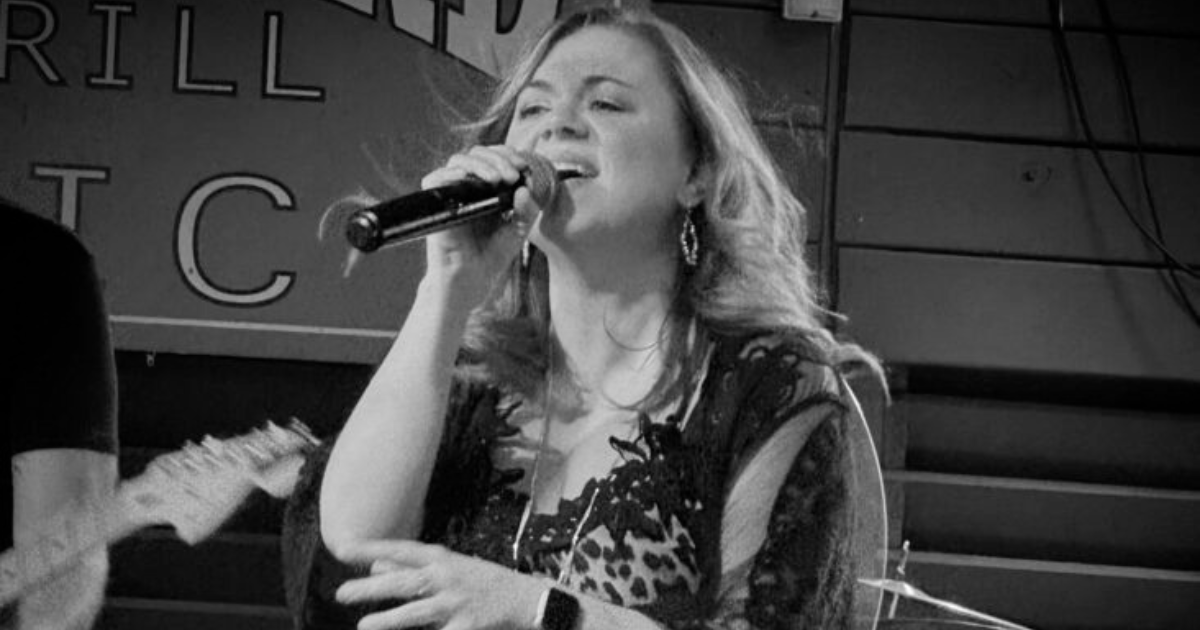
At 11 years old, Stephanie Rabus underwent open-heart surgery.
Thirty-three years later, she found herself dealing with her heart again.
And somewhere between those two moments, she built a life around singing.
There are coincidences.
Then there are circles so perfectly drawn that you have to wonder whether somebody knew where the story was going before you did.
Stephanie was born with pulmonary stenosis, a condition affecting the pulmonary valve and the heart’s ability to properly move blood. Doctors initially attempted balloon catheter procedures when she was young, but by age 11, surgery became necessary.
That same period of her life also brought another discovery.
Stephanie could sing.
Her father played drums for an Elvis impersonator who happened to live next door. Stephanie borrowed the microphone one day and sang “Part of Your World” from The Little Mermaid a cappella.
People listened.
Then they looked at one another.
Apparently, the kid could really sing.
Thirty-three years later, at 44, Stephanie underwent another heart procedure.
And almost simultaneously, she was preparing to release a song about refusing to give up on the dream she discovered when she was 11.
It’s called “I Told Me So.”
Sometimes subtlety is overrated.
When the Heart Changes the Story
Stephanie remembers enough about that first surgery to remember being scared.
She was a kid in Arizona.
It was summer.
There was a swimming pool in the backyard.
Other children were doing normal summer things while she was facing open-heart surgery and months of recovery.
The medical details were complicated.
The emotional reality wasn’t.
She was scared.
One memory remains particularly vivid.
Because Stephanie was afraid of needles, anesthesia was administered through a mask rather than an IV. The mask had a strong strawberry scent, presumably somebody’s attempt at making the experience less frightening.
It didn’t work.
As she went under, Stephanie remembers feeling like she was suffocating.
Her last conscious thought was that she was dying.
Then she woke up.
The surgery was over.
Recovery wasn’t.
There was pain.
Breathing exercises.
Restrictions.
A young body trying to understand why it couldn’t immediately return to everything it had done before.
But eventually it did.
And life moved on.
Thirty-Three Years Later
The problem with heart valves is that repairing one doesn’t necessarily mean you’ve finished thinking about it forever.
Years later, Stephanie began noticing heart palpitations she’d never experienced before.
Testing followed.
MRIs.
CT scans.
More appointments.
Doctors eventually diagnosed pulmonary regurgitation, essentially a leaking pulmonary valve.
Stephanie described the leak as roughly 36 percent and in the moderate-to-severe range.
One option was another open-heart surgery.
Stephanie’s reaction was fairly straightforward.
Please, no.
Beyond the obvious concern of another major operation, open-heart surgery would have required a lengthy recovery.
Three or four months away from performing isn’t a small inconvenience when singing is how you pay the bills.
Fortunately, medicine had changed substantially in the 33 years since her first operation.
Doctors were able to perform a transcatheter pulmonary valve replacement using what is called a Harmony valve.
Instead of opening Stephanie’s chest, the replacement valve was delivered through a catheter inserted near the groin and guided into position in the heart.
A procedure addressing the same organ that once required major surgery now left little more than a tiny entry point.
That’s remarkable.
So is what Stephanie did next.
She went back to work.
The Show Must Go On, Just Maybe From a Stool
Less than two weeks after the procedure, Stephanie was already performing again.
Not exactly at full capacity.
She sat on a stool more than usual.
She let other singers handle additional material.
She avoided pushing the big notes.
But she was there.
A few scheduled Illinois performances requiring a five-hour drive had to be canceled because the travel simply wasn’t realistic yet.
But a Broadway gig in Nashville?
Stephanie found a way.
The reason wasn’t some romanticized version of suffering for art.
It was considerably more practical.
Musicians don’t get many sick days.
There isn’t always paid medical leave.
The bills don’t become sentimental because you just had a heart procedure.
For working musicians, missing shows means missing income.
Stephanie eased back into performing because she had to.
She also wanted to.
There’s a difference between recklessness and knowing that eventually the body has to start doing what it does again.
Stephanie was careful.
But she wasn’t interested in staying still forever.
A Dream That Refuses to Leave
That makes “I Told Me So” feel almost unnervingly appropriate.
Stephanie wrote the song a couple of years earlier with Mark Roma and Greg Matthews.
The writing session wasn’t originally designed around some clever commercial concept.
They were talking.
All three understood the frustration of chasing creative careers.
Mark and Greg as songwriters.
Stephanie as an artist.
The highs.
The lows.
The moments when everything feels like it’s finally moving.
Then the stretches where nothing seems to happen at all.
Anyone who has spent significant time in the music business knows the cycle.
Confidence and doubt occupy the same room.
One part of you says you’re wasting your time.
Another refuses to quit.
Eventually, the conversation turned into the song.
“I Told Me So” is built around that second voice.
The one that believes.
The one that imagines a future version of yourself looking backward and saying:
See?
I told you I could do it.
Not “they told me.”
Not a manager.
Not a label.
Not a critic.
Not an audience.
I told me so.
That’s an important distinction.
One Writer Never Got to Hear It
The song also carries a weight Stephanie never intended when they wrote it.
After recording an early version, she reached back out through the group message from the original writing session.
She hadn’t spoken with Greg Matthews for some time.
Mark responded and explained that Greg had become seriously ill.
He might not be able to answer.
A few days later, Mark sent another message.
Greg had passed away.
He never heard the finished recording.
That’s difficult enough on its own.
It becomes even heavier when you remember what the song is about.
Greg had been enthusiastic about it during the writing session.
He believed Stephanie needed to record it.
And eventually she did.
The original voice memo from that session now carries an entirely different significance.
Greg.
A guitar.
The song before it became a production.
The first version of an idea he would never hear finished.
Stephanie cherishes that recording now.
Work tapes aren’t usually considered precious things.
Sometimes they become exactly that.
The Song Before the Record
Stephanie has written songs in several ways over the years.
When she’s alone, lyrics and melody can arrive almost simultaneously.
She’ll think of a line and hear the way it should be sung in her head.
As a younger songwriter, she sometimes wrote complete songs a cappella because she could hear the melody without having the instrumental ability to support it.
She is working on guitar now, but she still relies heavily on her ear.
She can sing an idea to a guitarist.
They find the chords underneath it.
The song begins taking shape.
With “I Told Me So,” the beginning was even simpler.
Greg played guitar.
They talked through ideas.
Lyrics started getting thrown around the room.
Someone offered a line.
Someone else improved it.
Then came that moment co-writers know well.
That’s it.
Lock it.
The work tape was a voice memo.
From there, the song eventually went directly toward the master.
No elaborate demo stage.
Just the song and enough confidence to start building.
The House of David
For the recording, Stephanie worked with producer and engineer Brandon Henniger at the House of David studio in Nashville.
Walking into a studio with history changes the atmosphere.
There are rooms where you immediately understand you’re not the first person who arrived hoping to make something matter.
Photos line the walls.
Names hang in the air.
Stories accumulate in the corners.
Stephanie compared the feeling to visiting the Grand Ole Opry.
The first time she attended the Opry, the significance of the room hit her emotionally.
She cried.
It’s not simply architecture.
For people who have spent years dreaming about country music, some places represent the dream itself.
Stephanie hasn’t performed on the Opry stage.
Yet.
That word matters to her.
She has been backstage several times through musicians she knows and has become increasingly familiar with the world surrounding it.
She’s close enough to see the circle.
Now she wants to stand inside it.
Finding the Right Key
“I Told Me So” changed almost immediately once the Nashville session musicians got involved.
Stephanie initially selected a key.
She began singing.
Something didn’t feel quite right.
Then one of the musicians, whom Stephanie believes was session leader Michael Webb, said what everyone needed to hear.
You can do this higher.
He recognized that the original key wasn’t sitting in Stephanie’s strongest vocal range.
They moved it.
Suddenly the song landed where it belonged.
That’s one of the values of working with elite session musicians that rarely gets discussed.
They’re not simply there to execute a chart.
They listen.
They understand singers.
They understand arrangements.
They understand where a song wants to sit.
And they’ve done it enough times to recognize the problem quickly.
Watching Nashville Musicians Do Nashville Musician Things
Stephanie has performed with bands for years.
She understands rehearsals.
Everybody learns the material.
You get into a room.
Work through it.
Fix the mistakes.
Run it again.
Nashville sessions operate differently.
The players walk in.
There’s a chart.
Someone counts.
They play.
And suddenly the thing sounds like a record.
For “I Told Me So,” that experience was still relatively new for Stephanie because she hadn’t always been present when musicians tracked her previous material.
On her album My Time Now, the producer handled the instrumental sessions separately before Stephanie returned later to record vocals.
This time she got to watch everything happen.
She saw the musicians hear the material and build around it.
The piano entered.
The arrangement expanded.
A work tape featuring one voice and one guitar suddenly became something larger.
Stephanie and Brandon’s girlfriend sat listening as the song came together.
“It’s so beautiful,” they kept saying.
That transformation never really gets old.
I’ve watched world-class session players do it countless times, and it remains one of the most impressive things about making records in Nashville.
They make difficult work look suspiciously easy.
Traditional Without Being Trapped in Time
The first version of the production leaned more traditional.
Stephanie loves ’80s and ’90s country, so there was nothing inherently wrong with that.
But she and the team didn’t want “I Told Me So” to sound like somebody had discovered an unreleased master sitting in a vault since 1992.
Traditional influence?
Absolutely.
Time capsule?
No.
They wanted enough modern production around the song to place it comfortably beside current country music without sacrificing what made the original arrangement work.
Over time they adjusted the production.
Balances changed.
Ideas evolved.
The song became a little more contemporary while maintaining its country foundation.
That’s a difficult balance.
Especially now, when country music itself seems increasingly willing to reach backward while moving forward.
Stephanie’s approach fits naturally into that space.
Honor what made the records great.
Don’t pretend nothing has changed since then.
Performance Before Perfection
When Stephanie returned for the dedicated vocal session, she approached the recording in a way I strongly prefer.
Sing the whole song.
Then listen.
The first verse works?
Keep it.
That chorus could be stronger?
Do it again.
A particular line doesn’t quite land?
Punch it.
But begin with a performance.
Another producer Stephanie previously worked with preferred grouping sections together—record all the verses while the voice sits in one place, then record choruses, then the bridge.
There is logic behind that.
It can create vocal consistency.
Stephanie simply prefers singing the story from beginning to end.
I agree.
Especially for singers who spend significant time performing live.
A song has momentum.
The first verse affects the chorus.
The chorus changes the way you enter the next verse.
The bridge feels different because you had to travel through the song to reach it.
You can assemble a technically perfect vocal one piece at a time.
That doesn’t guarantee it feels like somebody actually sang the song.
When Technology Helps, and When It Takes Over
Stephanie is also realistic about pitch correction.
She’s a perfectionist.
She wants the vocal right.
But she wants her vocal.
If an emotional performance is fantastic and one tiny note lands slightly flat, moving that note isn’t a moral crisis.
The technology exists.
Use it.
The problem comes when technology stops correcting the performance and begins manufacturing one.
Stephanie has little patience for artists who can only sound convincing after the studio has reconstructed the vocal from the ground up.
She wants people who can sing.
That may sound obvious.
The modern recording industry occasionally makes it necessary to say anyway.
I spent part of my own Nashville career tuning vocals, so I know how far that pursuit of perfection can go.
There were sessions where every word was tuned whether it needed correction or not.
Not because the singer couldn’t perform.
Because everybody else’s records sounded perfectly controlled, and nobody wanted theirs to be less perfect.
The irony is that perfection can eventually erase personality.
Stephanie understands that.
Fix what needs fixing.
Then leave the human being alone.
Taking Care of the Instrument
The voice has become even more important to Stephanie as she gets older.
She recently worked with a voice therapist after experiencing some hoarseness.
Doctors examined her vocal folds and found no nodules, which was good news, but there was some thickening that could be addressed through therapy and improved technique.
The examination itself involved sending a tiny camera through her nose and down toward the vocal folds.
Stephanie was awake.
For reasons I don’t completely understand, she wished she could watch.
I absolutely would not.
The therapy taught her more about breathing, hydration, vocal placement and the difference between simply forcing high notes and learning how to mix chest and head voice efficiently.
She also learned something singers frequently misunderstand.
Drinking a glass of water five minutes before singing doesn’t instantly hydrate your vocal cords.
Hydration is something you maintain.
Coffee?
Add water.
Alcohol?
More water.
Her vocal therapist had even toured with artists, sometimes reminding them to save the alcohol until after the show.
Turns out vocal longevity involves slightly more discipline than simply owning a microphone.
She Plans on Keeping the Voice
Stephanie has seen artists reach a point in their careers where the voice simply isn’t what it once was.
She doesn’t want that.
Range may change.
Hormones may affect tone.
Age may alter where certain notes live.
But she was told there’s no reason singers should simply expect to lose their voices if they properly care for them.
Stephanie takes that seriously.
She isn’t 20 anymore.
She is also not apologizing for being 44.
That’s another important part of her story.
Because country music has historically treated age—particularly for women—as though somebody flipped an expiration date on the artist.
Stephanie refuses to accept that definition of a career.
What Does “Making It” Mean Anyway?
Ask a young artist what making it means and the answer is usually easy.
Record deal.
Awards.
CMA stage.
Grammy.
Grand Ole Opry.
Fame.
Stephanie had versions of those dreams too.
She still wants some of them.
Especially the Opry.
But experience has changed the definition.
Today an independent artist can build an audience directly.
Social media.
Ticketed shows.
Merchandise.
Streaming.
Monetized content.
Fan communities.
You can support yourself through music without becoming so famous you can’t buy toilet paper at Walmart without signing autographs.
Stephanie isn’t sure she even wants that version anymore.
But she does want more.
She wants original shows where people buy tickets specifically to see her.
She wants the fanbase to grow.
She wants the income from original music to become more sustainable.
And yes, she wants to perform on the Grand Ole Opry.
Those aren’t unrealistic dreams simply because she reached her forties.
“I Told Me So” is practically her answer to anyone suggesting otherwise.
Broadway Isn’t Quite What Tourists Think
Stephanie already makes her living through music.
Part of that means working Nashville’s Broadway clubs.
To tourists, Broadway can look like the center of the country music universe.
Bands everywhere.
Packed clubs.
Thousands of visitors.
Music pouring through every doorway.
Surely the musicians are doing wonderfully.
Not necessarily.
The venues provide a base rate, but musicians often depend heavily on tips.
And tips are unpredictable.
Some days are good.
Some aren’t.
Stephanie described shifts where musicians might leave with only a small amount each.
Others might produce $100, $150 or considerably more.
A strong day at a place like Legends Corner can be worthwhile.
Another shift can make you wonder why you bothered loading the gear.
That’s working music.
The glamorous version doesn’t usually include somebody carrying a tip container through the crowd.
The real version does.
The Hardest Audience Isn’t Always the Smallest
Stephanie has also learned which crowds are difficult.
It isn’t necessarily the quiet room.
It’s the crowd that isn’t there for music in the first place.
They’re there to drink.
Party.
Get loud.
The band is effectively background music with amplifiers.
For a singer who actually cares about delivering a song, that can be frustrating.
Stephanie prefers the Nashville rooms that allow her to remain rooted in country.
’90s material.
Earlier country.
Miranda Lambert.
Little Big Town.
Carrie Underwood.
Songs that suit what she does.
She hasn’t felt tremendous pressure in her regular circuit to transform the set into something she doesn’t recognize.
Other Broadway rooms may require a different energy.
That’s fine.
Every room has a personality.
Not every room has to be hers.
Jerry Rabus, Once Again
There was never much mystery surrounding one of Stephanie’s most consistent supporters.
Her father, Jerry Rabus, has somehow become a recurring character on The Jay Franze Show without technically being a cast member.
He responds to Questions of the Day.
He shares Stephanie’s work.
He supports the show.
He supports her.
We have uttered the phrase “Jerry Rabus, father of Stephanie Rabus” enough times that it may eventually require its own trademark.
Stephanie describes him as endlessly enthusiastic about her career.
He was there when she recorded her vocals for “I Told Me So.”
He’s there reminding her to stay active on social media.
Post today.
Make the video.
Share the thing.
Keep moving.
He’s also apparently a fan of my book Standout or Fade Out, which means I am contractually obligated to describe Jerry as a man of exceptional judgment.
But this time Stephanie also wanted to make sure her mother received credit.
Her mother may not be as loud about the support.
She’s still there.
She attended Stephanie’s gigs regularly before health issues made that more difficult.
She has always believed in her daughter.
Not everybody supports publicly.
Some people simply remain beside you.
Both matter.
Support Sometimes Looks Like Family
Stephanie also has a small circle surrounding the music professionally.
Producer Brandon Henniger is connected to her life personally as well: Stephanie’s boyfriend Britt’s sister, Heather, is Brandon’s girlfriend.
The family tree takes a second.
The useful part is considerably simpler.
Stephanie happens to have a talented producer and engineer within her extended personal circle.
Sometimes Nashville networking really does become family networking.
Between Brandon, Britt, Heather, her parents, musicians, friends and collaborators, Stephanie understands that she isn’t chasing this completely alone.
That’s important.
Especially after decades.
Why Stop Now?
People occasionally ask Stephanie why she’s still doing this.
She’s 44.
The industry’s youth obsession is hardly a secret.
Shouldn’t the dream have happened already?
Shouldn’t she move on?
Stephanie’s answer is contained in the song.
Why?
Because she isn’t finished.
Because she’s already built a life where music is what she does.
Because success isn’t one single finish line.
Because she still sees another version of the career ahead of her.
And because there is a part of her that has always believed she can get there.
Think about the timeline.
At 11, Stephanie went through open-heart surgery.
Around that same age, she discovered she could sing.
She spent the next 33 years chasing music.
At 44, her heart required another intervention.
Within two weeks, she was back onstage.
And at almost the exact same moment, she was releasing a song she had written about continuing to believe in the dream when every reasonable voice might suggest letting it go.
You couldn’t manufacture that narrative if you tried.
I Told Me So
There will probably be more procedures.
Stephanie knows that.
The replacement valve may eventually need to be replaced again.
Maybe through another catheter procedure.
Maybe someday through surgery.
She can’t control that.
She can take care of herself.
She can protect her voice.
She can keep writing.
She can keep performing.
She can keep pushing toward the Opry.
The future will decide the rest.
That’s ultimately what “I Told Me So” represents.
Not certainty.
Belief.
There is a difference.
Certainty says you know exactly how the story ends.
Belief says you’re willing to keep moving even when you don’t.
Stephanie Rabus has spent most of her life doing exactly that.
A repaired heart.
A microphone.
A dream that apparently doesn’t understand when it’s supposed to leave.
Maybe someday Stephanie will stand on the Grand Ole Opry stage and look back on all of this.
The surgeries.
The tip jars.
The writing rooms.
The disappointments.
The sessions.
The gigs where nobody listened.
The people who told her she was getting too old.
And maybe she’ll finally get to say the line exactly the way it was meant to be said.
I told me so.