

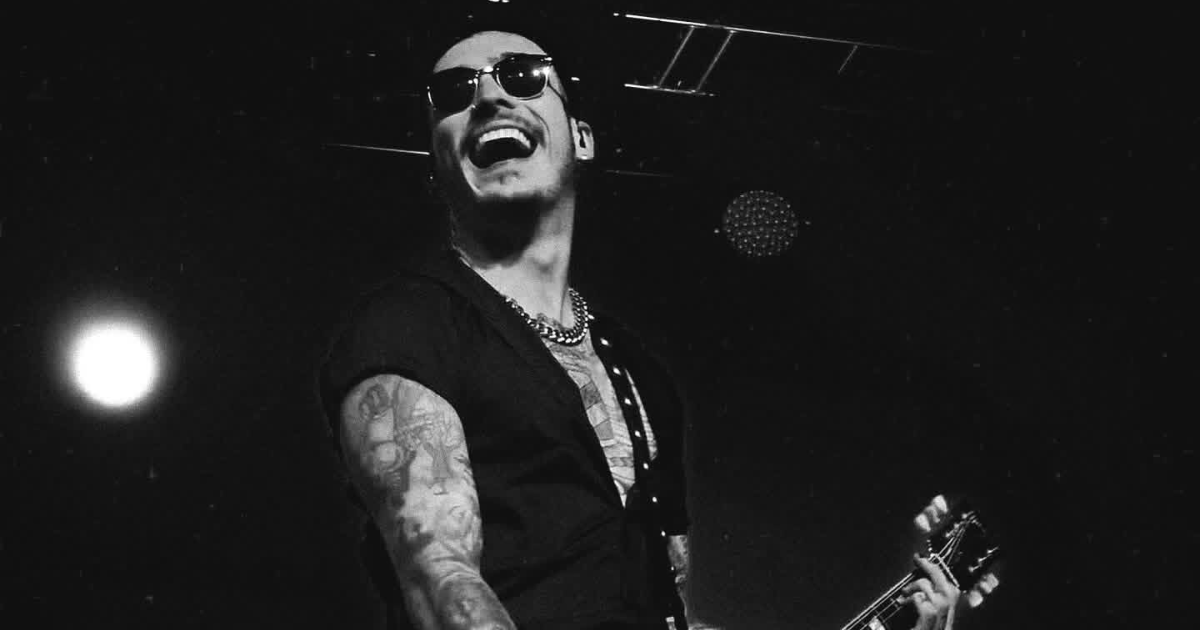
Kieran Robertson was 18 years old when he went to see Geoff Tate perform.
He was a fan.
That’s an important detail.
Kieran had grown up listening to Queensrÿche. He knew the records. He knew the guitar parts. He understood that this wasn’t exactly music designed for someone who learned three chords over the weekend and decided Monday morning seemed like a reasonable time to join a progressive metal band.
He met Tate after the show.
Got the picture.
Wrote some music for him.
Then, about a week later, the phone rang.
They needed a guitar player.
Suddenly the kid who had grown up listening to the music wasn’t standing in the audience anymore.
He was being asked to help play it.
Years later, Kieran isn’t simply touring alongside Geoff Tate.
He’s writing with him.
Recording with him.
Engineering his vocals in hotel rooms.
And helping create music connected to the next chapter of Operation: Mindcrime.
There are career paths.
Then there are stories that sound like somebody skipped several pages.
Just a Kid Who Loved Rock Music
Kieran grew up in Scotland loving rock music.
Queensrÿche.
Faster Pussycat.
The bands that made him look at a stage and think:
I want to do that.
He didn’t necessarily imagine he’d someday be doing it with them.
Today, Kieran splits his time between Geoff Tate’s band and Faster Pussycat.
He jokes about the two bands having joint custody of him.
When one gets tired of him, apparently the other takes over.
Not a bad arrangement.
Especially considering that before Tate called, Kieran was working as a bartender at Hard Rock.
And according to Kieran, he wasn’t particularly good at it.
A secret shopper once evaluated his performance and reportedly declared Kieran’s mojito the worst he’d had in ten years.
Some people receive subtle signs from the universe.
Kieran’s apparently arrived with mint and rum.
Fortunately, the guitar thing worked out.
The Phone Call
Kieran’s father works as a booking agent and tour manager in the UK and had booked Tate.
Kieran went along to the show as a fan.
He met Geoff.
They connected.
Kieran had already been making his own music, he’d released a solo album in Germany as a teenager, and he sent Tate some material.
Then the call came.
A guitarist was needed at the last minute for an acoustic tour.
Kieran was doing his own thing in Germany at the time.
He dropped it.
Flew out.
Quit the bartending job.
And tried not to think too hard about what had just happened.
The original role was relatively contained.
Rhythm guitar.
Acoustic arrangements.
No expectation that the 18-year-old newcomer immediately walk onstage and reproduce every classic Queensrÿche guitar solo ever recorded.
But Kieran understood something important.
Getting the opportunity wasn’t enough.
He had to prove he belonged there.
So he learned the material.
Really learned it.
Tate noticed.
Eventually Kieran received another offer.
Would he like to join the electric band?
That one didn’t require much deliberation.
Don’t Touch the “Jet City Woman” Solo
Stepping into music associated with Queensrÿche carries a particular responsibility.
These aren’t casual arrangements.
The guitar parts can be intricate.
The structures can be progressive.
The fanbase knows the records.
Every note.
Every detail.
Probably several alternate live arrangements from 1991 that nobody currently onstage remembers.
Kieran learned quickly.
Literally.
He says playing Tate’s music made him a considerably better guitarist in a short period of time.
What fascinates him about classic Queensrÿche is the way technical complexity remains musical.
Progressive music can occasionally become so focused on demonstrating technical ability that listening to it feels suspiciously like homework.
Queensrÿche managed something different.
Complex guitar arrangements.
Unusual musical choices.
Progressive structures.
Yet the songs could still carry something resembling pop accessibility.
Kieran wanted to understand why.
Not simply memorize the notes.
Understand the decisions.
That knowledge now feeds directly into the music he’s creating with Tate.
But there are boundaries.
Kieran has no interest in becoming the young guitarist who arrives and decides “Jet City Woman” desperately needs his personal reinterpretation.
He’s there to serve the music.
Not correct history.
Those Fans Know the Notes
That respect becomes considerably more important when the audience knows the material as well as the musicians do.
Kieran learned that early.
He remembers coming offstage and occasionally encountering a fan prepared to explain that a particular part was technically supposed to be something slightly different.
Those comments could ruin his week.
That’s the danger of performing music for a genuinely devoted fanbase.
They aren’t hearing “a Queensrÿche song.”
They’re hearing the guitar part they’ve listened to hundreds of times.
Possibly thousands.
Over the years, Kieran’s confidence grew.
He’s played the material long enough now to trust himself.
But he hasn’t lost the willingness to listen.
If a knowledgeable fan points something out and Kieran realizes they’re right, he’ll consider it.
He didn’t write the original material.
His responsibility is to perform it in a way that respects the people who did.
That’s a remarkably mature perspective for someone who entered this world so young.
He’s not trying to fill anyone’s shoes.
As he puts it, he’s trying to do the job.
Then He Started Writing With Geoff Tate
Learning the catalog was one challenge.
Writing new music with the man who helped create it was another.
Kieran writes constantly for multiple artists, and his process usually begins by imagining the person he’s writing for.
When he’s writing for Tate, he’ll construct nearly everything.
Drums.
Bass.
Guitars.
Arrangement.
Even a rough vocal melody.
He knows Tate will probably change the melody.
That’s the point.
The initial demo isn’t supposed to dictate the finished record.
It’s there to communicate a world.
Here’s the song.
Here’s the energy.
Here’s where my head is.
Tate takes it from there.
Sometimes Kieran won’t hear anything for months.
Then something comes back.
The DNA remains recognizable.
But Tate has rearranged pieces.
Added synthesizers.
Changed vocals.
Chopped guitar parts.
Reframed sections.
What Kieran originally sent has evolved into something considerably larger.
That’s collaboration.
The best version doesn’t belong entirely to either person.
It exists because both touched it.
Writing Inside Mindcrime
The challenge became considerably more interesting when the material started moving toward the next chapter of Operation: Mindcrime.
Kieran is very clear about one thing.
The story belongs to Geoff Tate.
The concept.
The narrative.
The world.
Kieran makes no claim to creating that part of it.
His responsibility is musical.
He wants the new songs to exist in the same sonic universe as the original Operation: Mindcrime.
That’s different from simply copying it.
And considerably harder.
Copy the original too closely and you’re making nostalgia.
Ignore it entirely and the connection becomes meaningless.
Kieran has spent years performing the first Mindcrime album with Tate, so he knows its movement almost instinctively now.
He understands how the record flows.
How the guitars function.
Where the dynamics shift.
How the music creates a space for Tate’s storytelling.
Now he can take those lessons into the writing process.
Not:
How do I write an old Queensrÿche song?
But:
What made those musical choices work, and how can that thinking inform something new?
That’s the right question.
“Power” Took Years
The new song “Power” demonstrates how slowly that process can develop.
Kieran first wrote the initial idea during COVID.
He sent it to Tate.
Tate liked it.
They worked on it.
Changed things.
Passed ideas back and forth.
Then Kieran didn’t hear much about it for a while.
Months later, the song had made its way to John Moyer.
Eventually Kieran heard what it had become.
His reaction was essentially:
Oh my God.
The process had taken somewhere around three or four years.
That’s another useful reminder about records.
The audience hears a song in a few minutes.
The people who made it may have been living with the thing for years.
The Studio Is Wherever They Happen to Be
The recording process for the project is considerably less glamorous than people might imagine.
There isn’t one sacred studio where everyone disappears for six months.
They’re recording everywhere.
Venues.
Studios along the tour route.
Hotel rooms.
Different countries.
Kieran and Tate both travel with portable recording rigs, which means a room can become a studio whenever the opportunity appears.
Sometimes that means constructing a makeshift vocal booth using whatever the hotel provides.
Bed frames.
Blankets.
Covers.
Rock-and-roll acoustical treatment.
Somewhere, an acoustician just developed a nervous twitch.
But it works.
And Kieran understands something I’ve always believed about recording.
The technically best sound isn’t automatically the best record.
Sometimes the performance matters more.
Sometimes the idea matters more.
Sometimes you capture something in a hotel room because that’s where the emotion happened.
If it needs to be recreated later, fine.
They’re going to be in Nashville next week.
Book a studio.
But don’t lose the idea because the room doesn’t have a million-dollar console in it.
Geoff Tate, Hotel Room Vocalist
There is also something slightly absurd about Kieran’s role in those sessions.
Imagine being the kid who grew up listening to Geoff Tate.
Now you’re sitting behind the recording rig.
You hit record.
You look through your improvised hotel-room studio setup.
And Geoff Tate is singing.
Kieran still has moments where the situation registers.
That’s Geoff Tate.
I’m engineering Geoff Tate.
The imposter syndrome hasn’t disappeared completely.
It’s simply learned to coexist with experience.
That’s probably healthy.
A little disbelief keeps gratitude intact.
Too much prevents you from doing the work.
Kieran appears to have found the balance.
Yes, Hotels Complain
Recording powerful rock vocals in hotel rooms does create one predictable technical problem.
Other hotel guests.
Kieran admits they’ve received noise complaints.
Frequently.
Sometimes someone recognizes they’re dealing with musicians and asks them politely to keep it down.
No problem.
Sometimes Kieran apparently feels tempted to explain:
Yes, but the person making the noise is Geoff Tate.
This argument has limited effectiveness with hotel management.
Rock history is important.
So is the person in Room 412 trying to sleep.
Let Someone Else Mix It
Once the recording is finished, Kieran knows when to let go.
That’s important.
He’s a songwriter.
Producer.
Guitarist.
He engineers.
He can mix.
But when you’re that deeply involved with a project, objectivity disappears.
Every snare drum becomes a philosophical crisis.
Should it be half a decibel louder?
Is that guitar slightly too forward?
Maybe the vocal needs something at 3 kHz.
Listen again.
Again.
Again.
At some point your ears stop hearing music and begin filing complaints.
Kieran prefers handing the final mix to Juan Ortega.
He trusts someone outside the center of the project to provide the perspective he no longer has.
I understand completely.
My wife has watched me listen to the same song thousands of times while insisting something is still “just a hair off.”
Kieran’s girlfriend has apparently experienced the same thing.
Her solution was wonderfully reasonable:
Why don’t you find one snare drum you like and use it on everything?
Because that would make life considerably easier.
We can’t have that.
The Viper Room
Then came one of those nights Kieran will probably be talking about decades from now.
The Viper Room.
Iconic room.
Los Angeles.
A celebration surrounding the new Mindcrime project.
Kieran has a personal relationship with the venue and its manager, Tommy Black. When discussions began about throwing an event, Kieran knew where he wanted it.
The Viper Room.
While it was still there.
The venue agreed.
Kieran took on the responsibility of helping throw the event.
Then the guest list started filling up.
Tate reached out to people.
Kieran contacted friends.
Rock musicians showed up.
John Moyer was there.
Members of Faster Pussycat came.
And suddenly Kieran had another realization.
He had to perform in front of these people.
There is something strangely comforting about performing for thousands of strangers.
You don’t know them.
They don’t know you.
Performing in front of your friends?
Terrifying.
Especially when your friends happen to include musicians from bands you’ve listened to for years.
Kieran walked onto the stage and began scanning the room.
There’s the bassist from Disturbed.
There’s a guitarist from Five Finger Death Punch.
Nothing intimidating about that.
Then Faster Pussycat’s Taime Downe started heckling him about his Scottish accent and demanding subtitles.
Kieran laughed.
The tension disappeared.
These weren’t rock stars judging him.
They were friends.
That changed everything.
Just a Kid From Scotland
That night gave Kieran one of those rare opportunities to see his life from the outside.
He’s standing onstage at the Viper Room.
He’s hosting an event.
He’s celebrating music he helped create with Geoff Tate.
The room is full of established musicians.
His father is there.
And somewhere inside all of that is still the kid from Scotland who simply loved rock music.
Kieran has experienced plenty of those moments.
Meeting Paul Stanley outside the Viper Room.
Playing shows with Bret Michaels and discovering that someone at that level can still take the time to be genuinely kind.
Joining Faster Pussycat after growing up listening to them.
There are apparently even better stories protected by NDAs.
We’ll have to wait for those.
But Kieran doesn’t talk about these moments as though he’s entitled to them.
He repeatedly comes back to the same word.
Grateful.
Mindcrime Isn’t Just a Concert
Performing Operation: Mindcrime also requires more than playing the record correctly.
It’s theatrical.
The album functions as a story, and Tate approaches the performance differently than a standard greatest-hits show.
Kieran can see the shift.
Tate enters the character.
The mindset changes.
The production supports it.
For the current presentation, Cloda McCarthy performs the role of Sister Mary. She’s also involved with the upcoming material.
There are lasers.
Characters.
Production elements.
The entire album performed as a complete work.
That’s important because Mindcrime was never designed to be a random collection of unrelated songs.
Pulling it apart changes the experience.
Presenting the entire work allows the audience to step back inside the world that made the album resonate in the first place.
Kieran isn’t simply playing a guitar part.
He’s part of the storytelling mechanism.
The Audience Keeps Getting Younger
The original Queensrÿche fanbase is famously devoted.
Kieran compares it to bands like Rush.
These are listeners who don’t casually enjoy the catalog.
They study it.
But something else has started happening.
The audience is expanding generationally.
Parents who grew up listening to Tate bring their children.
Those kids grow older.
Some begin bringing people of their own.
Kieran notices younger fans in the audience.
That means something to him.
Especially when a 13-year-old guitarist approaches after a show.
Kieran can hand the kid a pick.
Say keep playing.
And perhaps, somewhere in that interaction, the cycle starts again.
After all, Kieran knows better than most that the kid in the audience isn’t necessarily staying there.
Rock Crowds Speak Different Languages
Years of touring internationally have also taught Kieran that audiences react differently depending on where you happen to plug in the amplifiers.
American audiences?
Loud.
Energetic.
Jumpy.
They let you know when they like something.
Europeans may sing along with guitar melodies.
British audiences can be more inclined to stand, watch and absorb the performance.
Japanese crowds have their own rhythm of response.
Kieran enjoys all of it, but he has developed a particular affection for performing in America.
Americans like showmanship.
Theatrics.
Or, as Kieran put it in wonderfully Scottish fashion, a bit of “panto.”
We eventually translated.
Pantomime.
Theatricality.
A show.
That makes Operation: Mindcrime a particularly good fit.
Joint Custody With Faster Pussycat
Then there’s Kieran’s other job.
Faster Pussycat.
Managing schedules between two touring rock acts is becoming increasingly complicated, but both camps have been supportive.
Tate works with multiple guitarists, which provides flexibility when Faster Pussycat needs Kieran elsewhere.
It isn’t a rivalry.
It’s more like an extended rock-and-roll family.
Or joint custody.
One band gets Kieran for a while.
Then the other.
Somewhere in between, presumably, he goes home.
Occasionally.
The International Traveling Circus
Tate’s touring band itself reflects the international nature of Kieran’s career.
Kieran is Scottish.
Another guitarist is French.
Another is Italian.
The drummer is from Seattle.
The bassist is Scottish.
Cloda is Irish.
Backstage becomes a collection of accents, personalities, jokes and musicians constantly playing music.
The support musicians bring acoustic guitars.
People jam.
People sing.
Pranks happen.
Kieran describes bassist Jack as particularly fond of masks and frightening people.
The backstage environment is less mysterious than fans might imagine.
There isn’t necessarily some decadent rock-star fantasy waiting behind the curtain.
Sometimes it’s chips.
Sprite.
Coke.
Beer.
Jameson.
Salami.
Bread.
A truly unreasonable amount of lunch meat.
Apparently This Is Spinal Tap wasn’t exaggerating as much as we’d hoped.
The People Behind It
When I asked Kieran who deserved recognition behind the scenes, he couldn’t narrow it to one person.
His mother and father.
His father has supported the career from the beginning and was out tour managing the Tate run when we spoke.
Geoff and Susan Tate, for believing in him and continuing to give him opportunities.
His girlfriend, Heather, for tolerating the chaos surrounding the album and Kieran’s tendency to become completely consumed by the work.
The band.
The crew.
John Moyer and the production team.
Kieran understands that none of this is really a solo story.
Even the kid who gets the remarkable phone call needs people around him once he answers it.
Dreams Do Come True
There is an easy version of Kieran Robertson’s story.
Teenage Queensrÿche fan meets hero.
Hero hires him.
Dream comes true.
The end.
It’s a good story.
It’s also incomplete.
Because getting the phone call isn’t what kept Kieran there.
Preparation did.
Work did.
Respect did.
He studied the music rather than assuming he already understood it.
He listened when fans corrected him.
He learned why the original arrangements worked.
He became a better guitarist.
Then a collaborator.
Then a writer helping create something new.
That’s the part of the story young musicians should pay attention to.
You can’t control whether Geoff Tate happens to need a guitarist a week after you meet him.
You can control whether you’re ready if the call comes.
Kieran was.
From Fan to Mindcrime
Kieran Robertson still sounds slightly surprised by his own life.
That’s part of what makes him interesting.
He hasn’t forgotten the distance between the audience and the stage because, in his mind, it wasn’t that long ago that he was standing on the other side.
He knows what the songs mean to the fans because he was one.
He knows the original guitar parts deserve respect because he loved them before anyone paid him to play them.
And now he’s in the unusual position of helping Geoff Tate carry that musical world forward.
Not replacing what came before.
Not rewriting the legacy.
Adding another chapter.
Somewhere out there is another kid with a guitar listening to Operation: Mindcrime and imagining what it would feel like to stand onstage playing those songs.
Kieran Robertson used to be that kid.
Now he’s the guy onstage handing him a guitar pick.
That’s a hell of a journey.
And apparently, it’s only getting started.