

There is a version of the music business that exists mostly in movies.
You start a band. Write a few songs. Play some shows. Somebody important walks into a club, hears you, and suddenly you’re on a tour bus wondering where to put the platinum records.
Then there’s the version most musicians actually know.
You work a job.
You raise a family.
You rehearse after work. You buy gear when you can afford it. You load into clubs, play the show, load everything back out, go home, sleep for a few hours and return to real life the next morning.
Somewhere in between, you try to make something meaningful.
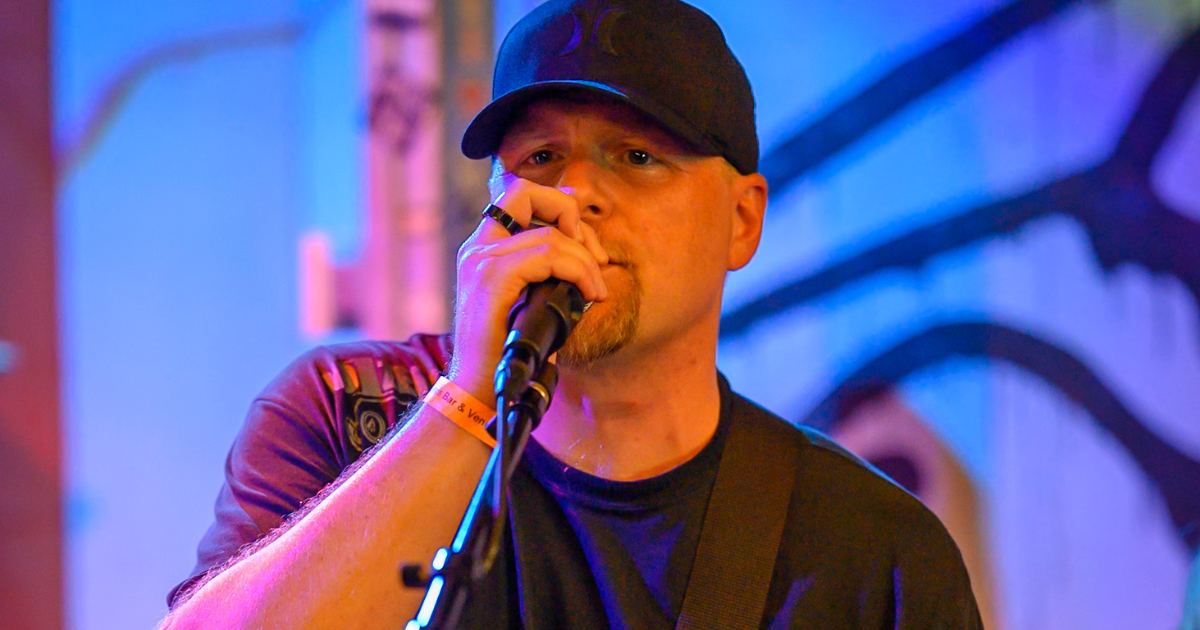
Asayda frontman and guitarist Mark Frye knows that version.
He’s been playing music around Cincinnati for years, through different bands, different lineups and different stages of life. These days, he has a career in IT, a wife, two young kids and all the responsibilities that come with them.
Yet when I asked whether he still had aspirations beyond the local scene, there wasn’t much hesitation.
“The dream doesn’t ever die,” he said. “It can’t ever die.”
That probably tells you more about Asayda than a genre label ever could.
A Cincinnati Education
Mark grew up in Cincinnati, which means his musical education includes a collection of venues that have helped define the city’s rock scene.
Bogart’s occupies a particularly important spot.
He remembers being 16 years old in 1997 and heading there to see Deftones. One of the opening bands was a group most people in the room apparently knew very little about.
Limp Bizkit.
This was before “Faith” and before the band became impossible to avoid.
Mark remembers the lights going down and Limp Bizkit launching into “Pollution.” The floor erupted.
He was standing roughly halfway back in a sold-out room and looked behind him.
Everybody was moving.
“I thought the floor was gonna collapse,” he recalled.
For Mark, that night was bigger than discovering a band before it became famous.
“I think that’s actually probably the moment that I fell in love with heavy music.”
That’s the thing about local venues.
We tend to measure their importance by the artists who eventually become famous enough to have played there.
But that’s only half the story.
Their real value is what happens to the people in the audience.
Some kid walks into a room, sees a band and leaves wanting to make music.
Years later, he’s the one onstage.
The Rooms That Build a Scene
Since moving to the Cincinnati area, I’ve been working my way through many of the venues Mark grew up attending.
That made our conversation partly an interview and partly my personal orientation to Cincinnati rock and roll.
Bogart’s.
Annie’s.
Ludlow Garage.
Taft Theatre.
Southgate House Revival.
Riverbend.
Each has a different personality.
Mark describes Cincinnati as a “big, small town,” and its music scene seems to operate the same way. There isn’t one neighborhood or genre that completely defines it. Music stretches from downtown into Clifton, across the river into Covington and Newport, and into clubs and breweries scattered throughout the region.
For rock and metal, though, those smaller rooms matter.
Mark remembers seeing Godsmack at Annie’s when they were still relatively unknown, opening for Down. He saw Royal Blood in a tiny room beneath the Taft Theatre with perhaps 60 people in attendance.
Then there’s one of my new favorite pieces of Cincinnati music history: Sudsy Malone’s.
Mark played there with an earlier band, One Finger Grip.
It was a laundromat.
With a bar.
And live music.
People could literally sit on washers and dryers watching the band while doing laundry.
Coming from Boston, I thought my Ohio laundromat experience was strange enough. Years ago, while attending the Recording Workshop in Chillicothe, I encountered one advertising laundry, milk, guns and ammo.
Apparently Ohio has been trying to revolutionize the laundromat industry for decades.
Mark’s version just had a better soundtrack.
Finding the Right Dysfunctional Family
Asayda wasn’t Mark’s first band.
He started playing guitar at 15 and later joined One Finger Grip, initially as a guitarist with no intention of becoming the singer.
Then the band needed vocals.
Mark figured he could sing a little.
One song became another, and eventually he found his voice.
After One Finger Grip ended, he and bassist Brian Smith moved into acoustic music with Two-Bit Acoustic. Mark continued searching for another heavier project, answering six or seven Craigslist ads and auditioning for different bands.
The problem wasn’t necessarily musicianship.
There were plenty of talented players.
He simply didn’t connect with the people.
That’s something musicians sometimes learn later than they should.
Being great at your instrument isn’t enough.
In Nashville, I’ve heard the phrase for years: you have to be a good hang.
There are too many people who can play.
If two musicians can both handle the gig, I’m hiring the person I can stand being around for the next twelve hours.
Mark sees bands as “dysfunctional families.”
He’s right.
You need to be able to tell someone his idea doesn’t work.
Someone needs to be able to tell you that your vocal sounds terrible.
Then everybody has to remain friends long enough to order dinner.
The important word isn’t dysfunctional.
It’s family.
When Mark answered the Craigslist ad that eventually led him to Asayda, he found that connection.
The lineup has changed over the years, as lineups do. Mark and guitarist/backing vocalist Brian Trester have remained the constants. Brian Smith eventually joined on bass, bringing a friendship with Mark that stretched back more than a decade. Drummer Shawn later completed the current lineup.
Life has dictated some of those changes.
Children.
Careers.
Responsibilities.
Mark doesn’t resent that.
Family comes first.
The trick is finding the people whose lives, personalities and ambitions can fit together long enough to keep creating.
He believes Asayda has found that group.
Write Something You Want to Hear
That stability is arriving at an important time.
Asayda is working on a new album, and Mark believes the band may be in its strongest creative position yet.
The reason isn’t that they’ve discovered some formula guaranteed to produce a hit.
It’s almost the opposite.
They’re increasingly comfortable ignoring the formula.
“We’re gonna write stuff that we like,” Mark said. “We hope everybody loves it. I mean, that’s fantastic that everybody loves it. But more than anything, we have to love it.”
That philosophy is pushing the new material in different directions.
Mark doesn’t want to write eight versions of the same song.
We’ve all seen that concert.
The first three songs hit you like a truck.
By song eight, you start wondering whether the band has been playing one 45-minute song with unusually long pauses.
Asayda wants variety.
Heavy music can still be melodic.
Aggressive music can still leave room for dynamics.
A record can move without losing its identity.
Mark pointed to Australia’s 12 Foot Ninja as an extreme example of a band willing to jump between heavy music, acoustic passages, jazz, Latin influences and seemingly whatever else interested them.
Asayda may not take those changes quite that far.
But Mark likes the philosophy.
Keep people guessing.
Becoming the Alchemist
The new album is also allowing Mark to indulge another side of his personality.
He’s producing much of it himself.
His formal audio-production education?
Curiosity.
Mark works in IT, and when something technological interests him, his instinct is apparently to disappear down the rabbit hole until he understands it.
He began seriously teaching himself recording while working with Two-Bit Acoustic, eventually mixing, mastering and producing an entire album.
His first software of choice wasn’t exactly designed for rock bands.
FL Studio.
Primarily known at the time as beat-making software.
He made it work.
Since then, he’s used Pro Tools, Studio One and other tools, gradually building what he jokingly calls a “pseudo studio” at home.
For this Asayda record, that setup is becoming part of the creative process.
Mark compared producing to being an alchemist surrounded by beakers.
Add some of this.
A little of that.
And occasionally discover that the entire experiment was a terrible idea.
That’s part of the appeal.
Brian Trester might bring in the framework of a song. Mark works with it. Shawn and Brian Smith add their ideas. The band records something and collectively decides they’ve nailed it.
Then everybody listens away from the studio.
Nope.
Back downstairs.
When Unlimited Options Become the Problem
There is, however, a danger in recording yourself.
There is no clock.
I’ve spent enough of my life in studios to know that a ticking clock isn’t always the enemy.
A traditional studio forces decisions.
You arrive prepared because you’re paying for the room, the engineer and everyone involved.
Mark remembers recording an earlier EP at Refraze Recording Studios in Dayton. He walked in to cut vocals and found himself standing in front of an impressive microphone.
Then the producer helpfully told him that the singer from Goo Goo Dolls had used it the previous week.
No pressure.
At home, nobody is standing behind the glass watching the budget.
That’s liberating.
It’s also dangerous.
You can always redo the guitar.
Add another vocal.
Change the drums.
Try one more part.
Remix everything.
Finish the mix.
Then decide it needs one tiny addition that requires changing half the mix.
Eventually somebody has to say the record is done.
Asayda is still early enough in the process that experimentation is welcome.
But Mark knows the band will eventually have to stop being alchemists and start being finishers.
A Crazy Time to Be a Musician
Technology is also changing what Asayda can put on the record—and eventually reproduce onstage.
For the album, Shawn is recording with an electronic drum kit rather than a traditionally miked acoustic kit.
That decision opens another world of possibilities.
Electronic sounds.
Samples.
An 808-style hit.
A specific sound created for a particular moment.
Those options can then become part of the live performance without turning the show into musicians playing along to prerecorded backing tracks.
Mark knows some musicians still resist modelers, electronic drums and similar technology.
His response is practical.
He’s still playing.
Shawn is still playing.
The instrument is being performed.
The technology simply gives them access to sounds that would otherwise require a warehouse full of equipment.
Mark remembers when his rig involved a Peavey half-stack and a rack-mounted EQ.
Today, if he wants a particular sound, chances are somebody has figured out how to put it in a box.
“It’s a crazy time to be a musician,” he said.
The challenge now isn’t access.
It’s restraint.
Just because you can use a completely different guitar tone, drum kit and production style on every song doesn’t mean you should.
Asayda wants experimentation while maintaining enough sonic consistency for the project to feel like an album.
The Album Still Matters
That word, album, is intentional.
Like many independent artists, Asayda has spent recent years releasing singles.
Mark understands why.
A single creates another opportunity to get people’s attention.
Release one song.
Six weeks later, give them another.
Two months later, remind them again.
Drop an entire album at once and, within a few months, you’re promoting something the internet has already decided is old.
Still, the band wants to make an album.
The likely compromise is a staggered release: singles arriving over time while the unreleased tracks remain part of the larger project waiting behind them.
Mark doesn’t expect the complete record in 2026.
Early 2027 is more realistic.
Part of that timeline comes from the reality behind the music. Mark dealt with medical issues that slowed the band’s progress, and Asayda has also been balancing recording with live performances.
The goal after their upcoming shows is simple.
Put their heads down.
Finish the work.
Then get back in front of people.
Make the Cover Yours
When Asayda returns with the new material, not everything audiences hear will necessarily be original.
Mark likes the idea of including a few surprises.
One example already exists in the band’s live show: Billy Idol’s “White Wedding.”
The important part is that Asayda doesn’t simply play “White Wedding.”
They play their “White Wedding.”
That’s an important distinction.
There is nothing wrong with performing a song faithfully, and tribute bands have built entire careers around doing exactly that.
But Mark prefers taking something familiar and filtering it through Asayda.
The audience already knows the words.
Now give them a reason to hear the song differently.
And yes, Mark is still waiting for Billy Idol to join them onstage.
Billy, apparently you’ve been called out.
Sixty People or Ten Thousand
Near the end of our conversation, Mark finally delivered the Royal Blood story he’d promised earlier.
Years ago, a friend brought him to the small ballroom beneath the Taft Theatre.
There might have been 60 people there.
Royal Blood walked onstage.
Two guys.
Bass and drums.
Mark initially wondered whether half the band had failed to show up.
Then they played.
They destroyed the room.
Mark had never seen anything quite like it.
Later, he saw Royal Blood again at a festival.
This time there were thousands of people in front of them.
The audience had changed.
The band hadn’t.
Same energy.
Same commitment.
Same determination to play the show like it mattered.
That’s what stayed with Mark.
And maybe that’s the clearest picture of what he wants for Asayda.
Not necessarily fame for fame’s sake.
Not some fantasy about abandoning every responsibility and pretending everyone is still 22.
He wants the music to reach people.
He wants the band to grow beyond Cincinnati.
He wants more people standing in front of the stage.
But whether it’s 60 or 10,000, the responsibility is the same.
Play like it matters.
The People Who Make the Dream Possible
When I asked Mark to name an unsung hero, he didn’t choose another musician.
He chose the families.
His wife.
His children.
The families behind the other members of Asayda.
Because every rehearsal has a cost.
Every show means time away.
Every recording session occupies hours that could have gone somewhere else.
For musicians with families and careers, pursuing music isn’t an individual decision.
Everyone around them participates in some way.
Mark also extended that gratitude to the independent venues that continue putting local bands onstage.
Those places could often make their lives easier.
Hire a DJ.
Run a college night.
Pack the room.
Instead, many keep taking chances on musicians.
They give local bands somewhere to fail.
Somewhere to improve.
Somewhere to become good.
And occasionally, somewhere to become great.
Mark knows what those rooms mean because he grew up in them.
He was the 16-year-old kid standing inside Bogart’s while an unknown Limp Bizkit shook the floor.
He watched an unknown Godsmack walk onto the stage at Annie’s.
He stood with roughly 60 people watching two unknown guys called Royal Blood tear apart a tiny room.
Now he’s on the other side of the barricade.
Maybe there’s another 16-year-old standing somewhere in the crowd watching Asayda.
Maybe that kid goes home and picks up a guitar.
That’s the cycle.
Careers change.
Families grow.
Priorities shift.
The music business changes almost daily.
The dream changes with it.
But for the people who truly love doing this, Mark is right.
It doesn’t die.
It just gets smarter.
And maybe a little louder.