
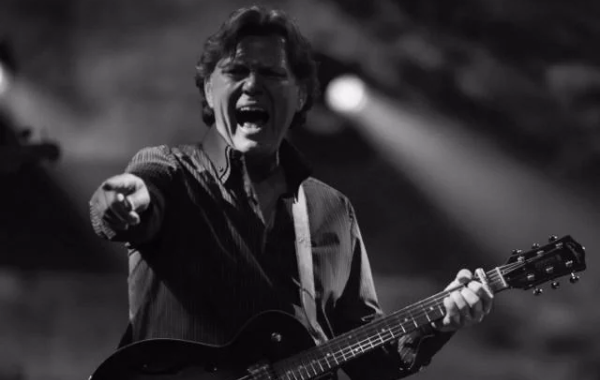
From learning guitar by ear in the mountains of East Tennessee to recording with Nashville’s finest and sharing the stage with Reba McEntire and Brooks & Dunn, guitarist Jeff King has built a remarkable career by remembering one simple rule: The song always comes first.
By Jay Franze | Driving Red: Music Magazine
There’s a certain kind of musician in Nashville who doesn’t need an introduction.
You might not recognize his face. You might not even know his name. But you’ve heard him.
He’s the guy playing the guitar part that makes a chorus come alive. The one who knows when to step forward, when to pull back, and when the smartest thing he can do is stay out of the singer’s way.
Jeff King is one of those musicians.
I’ve had the pleasure of working with Jeff over the years, and there’s something I’ve always appreciated about him. He’s an exceptional guitar player, but he’s also the kind of guy who makes a recording session enjoyable. If I walked into a studio and saw Jeff’s name on the musician list, I knew we were going to get some great music recorded.
I also knew there would be plenty of laughter.
Jeff has never been afraid to have a little fun at his own expense, and in an industry where some musicians take themselves far too seriously, that’s a refreshing quality.
But don’t mistake his easygoing personality for a lack of discipline.
Behind the jokes is a musician who has spent decades developing his craft, learning from some of the greatest players in Nashville, and contributing to recordings that have become part of country music history.
He’s worked with legendary producers, played alongside musicians whose names belong in the history books, and spent years performing with artists including Patty Loveless, Reba McEntire, and Brooks & Dunn.
When we recently reconnected, it felt less like an interview and more like catching up with an old friend.
We talked about everything from his childhood in East Tennessee to the Nashville session scene, the recording of Lee Brice’s “I Drive Your Truck,” and the surprisingly cold experience of performing on Late Show with David Letterman.
And somewhere along the way, Jeff reminded me of something that every musician, producer, and engineer should remember.
The best players aren’t necessarily the ones who play the most notes.
They’re the ones who know which notes matter.
A Guitar, a Record Player, and a Small Town in East Tennessee
Jeff grew up in Townsend, Tennessee, a small town near the Great Smoky Mountains.
It wasn’t exactly a thriving entertainment destination.
In fact, Jeff remembers the town having virtually no live music venues.
There was bluegrass, of course. His cousin would play on the front lawn on Sunday afternoons, and that was part of the musical environment around him.
But Jeff wasn’t particularly drawn to bluegrass.
His musical education came from somewhere else.
The record player.
He spent hours in his bedroom listening to artists such as the Eagles, the Marshall Tucker Band, and the Atlanta Rhythm Section.
Those records became his teachers.
And one song in particular changed everything.
Dobie Gray’s “Drift Away.”
Jeff’s aunt owned a 45-rpm single of the song, and he remembers listening to it repeatedly, completely fascinated by what he was hearing.
There was something about the sound, the feel, and the emotion that captured his imagination.
He wanted to understand how musicians could make an instrument communicate that way.
At around ten years old, Jeff discovered an acoustic guitar in the back of his uncle’s closet.
That guitar became the beginning of a lifelong obsession.
And like a lot of young musicians growing up before the internet, he had to figure things out the hard way.
There were no online tutorials.
No videos explaining every note.
No convenient way to slow down a recording without changing the pitch.
If you wanted to learn a guitar part, you listened.
Then you listened again.
And again.
Sometimes Jeff would slow the record player or physically drag a finger against the turntable to hear a passage more clearly.
It’s a method that would probably horrify an audiophile.
But it worked.
He learned to separate the different guitar parts in a recording and understand how they fit together.
When he listened to the Eagles, he wasn’t simply memorizing notes.
He was trying to understand why those notes worked.
He remembers studying the guitar work on “I Can’t Tell You Why,” a song whose melodic restraint and emotional phrasing made a lasting impression.
That approach became the foundation of his musicianship.
Jeff wasn’t interested in playing fast just for the sake of playing fast.
He wanted to play with feeling.
And that’s a lesson that would follow him all the way to Nashville.
The First G Chord
Although Jeff largely taught himself by ear, he didn’t do it entirely alone.
A family friend named Ronnie Sullivan came over and showed him a few basic chords.
One of the first things Sullivan taught him was “Wildwood Flower.”
Jeff practiced it relentlessly.
The guitar wasn’t particularly comfortable to play, either.
He remembers the strings being painfully difficult for a beginner.
But he kept working.
Sullivan’s encouragement gave Jeff something important.
A starting point.
One chord became another.
One song led to the next.
And every small improvement made him want to learn something more challenging.
It’s easy to overlook those early influences when talking about a musician who’s gone on to work with some of the biggest names in country music.
But Jeff hasn’t forgotten.
Decades later, when I asked him about the people who helped shape his career, Ronnie Sullivan was one of the first names he mentioned.
All because somebody took the time to show a kid his first G chord.
An Engineering Degree and a Dream
Music wasn’t Jeff’s only interest growing up.
He played sports throughout high school and eventually attended East Tennessee State University.
He earned a degree in engineering.
That’s right.
One of Nashville’s most accomplished guitarists had a perfectly respectable career option that didn’t involve hauling amplifiers into recording studios.
His parents probably thought that was a wonderful idea.
Jeff had other plans.
He’d played in local bands during college and discovered something that changed his perspective.
People would actually pay him to play guitar.
He remembers an early performance at an Elks club in East Tennessee.
After the band settled its expenses, each musician walked away with about thirty dollars.
For a college student in the late 1970s or early 1980s, that felt like serious money.
Jeff started doing the math.
If he could make thirty dollars a night, maybe he could earn sixty dollars in a weekend.
Suddenly, the music business looked pretty attractive.
Of course, Nashville had a few surprises waiting for him.
After graduating, Jeff decided to move to Music City.
His reasoning was practical enough.
He loved music and wanted to see whether he could build a career playing guitar.
If that didn’t work, he could always fall back on engineering.
It sounded like a reasonable plan.
Then he walked into a Nashville nightclub and heard Brent Mason.
Welcome to Nashville. Here’s Brent Mason.
Imagine moving to Nashville because you believe you’re a pretty good guitar player.
You’ve played in bands.
You’ve learned songs.
You’ve even made a little money.
Then somebody tells you about a guitarist you should go hear.
So you walk into a club.
And there’s Brent Mason.
For anyone unfamiliar with Nashville’s session scene, Brent Mason is one of the most respected guitarists in modern country music.
His playing combines extraordinary technical ability with impeccable timing, tone, and musical judgment.
He’s the kind of player who can make something incredibly difficult sound effortless.
Jeff remembers hearing him for the first time shortly after arriving in Nashville in 1983.
And suddenly realizing how much work he had ahead of him.
Jeff joked that, on a scale of one to ten, he was probably about a 0.3.
That’s a pretty harsh self-assessment.
But it tells you something about his attitude.
Instead of being discouraged, Jeff got to work.
He began visiting the club several nights a week, spending hours watching Mason play.
He’d listen carefully, take mental notes, and go home to work on the things he’d heard.
Over time, the two became friends.
And that friendship has continued for decades.
There’s something important about that story.
Jeff didn’t see a better musician as a threat.
He saw an opportunity to learn.
That attitude would become one of the defining characteristics of his career.
The Patty Loveless Years
Jeff moved to Nashville in 1983 and spent his early years playing clubs, meeting musicians, and developing his skills.
Then, in 1985, an opportunity arrived that would change his career.
Patty Loveless was assembling her first band.
Jeff got the job.
He would spend roughly five and a half to six years touring with her.
And those years became an education unlike anything he’d experienced before.
Playing in a successful country artist’s band requires more than knowing the chords.
You have to understand the recordings.
The arrangements.
The tones.
The phrasing.
And the subtle details that make a guitar part recognizable.
Jeff was determined to reproduce those elements as accurately as possible.
He studied the records and experimented with different guitars and equipment.
He also benefited from the advice of musicians and producers who understood the sounds behind the recordings.
One of those people was Emory Gordy Jr.
Gordy had an extraordinary musical background, including work with Elvis Presley, John Denver, and numerous major recording artists.
He encouraged Jeff to pay closer attention to specific guitar tones and playing styles.
Sometimes that meant using a Telecaster.
Sometimes it meant studying the work of players such as Albert Lee or Ray Flacke.
The lesson was simple.
Getting close wasn’t enough.
If a part required a particular sound or technique, Jeff needed to understand how to reproduce it.
He began exploring string benders, different guitar configurations, and the subtle inflections that distinguish one player’s style from another.
And every night onstage became another opportunity to improve.
Jeff joked that he was constantly falling short of perfection.
But listening to him describe those years, it’s clear that the pursuit itself made him better.
Walking Away From a Steady Paycheck
By the early 1990s, Jeff was beginning to receive calls for recording sessions.
At first, they were occasional demos.
Then the calls became more frequent.
He’d be on the road with Patty Loveless when somebody would contact him about recording a couple of songs in Nashville.
And he couldn’t always accept.
That created a difficult decision.
Touring with Patty provided steady work and a reliable income.
Session work offered something different.
An opportunity to become part of Nashville’s recording community.
Jeff had always wanted to explore that side of the business.
Eventually, he realized he needed to make a choice.
Around 1991 or 1992, he called Patty and told her he wanted to pursue studio work.
He remembers hanging up the phone and realizing that he’d just walked away from a dependable paycheck.
He had no guarantee that the session calls would continue.
But Patty was supportive.
In fact, she encouraged him to contact producers such as Tony Brown and Emory Gordy.
She suggested he spend time observing sessions and learning from established players.
Jeff still speaks about Patty with tremendous affection.
He credits her not only with giving him an important early opportunity but also with supporting his decision to pursue something new.
And that support mattered.
Because breaking into Nashville’s session scene wasn’t easy.
Two Sessions Become Four. Four Become Eight.
Jeff started taking every recording opportunity he could.
A couple of calls each month became four.
Then eight.
Eventually, the schedule became almost impossible to manage.
By the late 1990s and early 2000s, Nashville’s recording business was operating at an extraordinary pace.
Jeff remembers leaving home around nine in the morning and returning at ten at night.
Five or six days a week.
Sometimes more.
It was exhausting.
But it was also exactly what he’d worked so hard to achieve.
And that created an interesting problem.
When you’ve spent years hoping the phone will ring, it’s difficult to start saying no once it does.
Session musicians understand that dilemma.
Turn down too many calls, and you begin worrying that people will stop calling altogether.
So you keep working.
You take the early session.
Then the afternoon session.
Then maybe something in the evening.
And before long, your calendar looks like somebody spilled a box of appointments across it.
But Jeff loved the work.
More importantly, he loved the people.
Nashville’s Session Community
One of the things Jeff remembers most fondly about those years is the community of musicians.
The same players would appear on different sessions.
Drummers.
Bassists.
Keyboardists.
Steel guitarists.
Acoustic players.
Electric guitarists.
Everybody knew everybody.
They knew each other’s families.
They celebrated each other’s successes.
And they learned from one another.
Jeff found himself recording alongside players such as Reggie Young, Steve Gibson, Chris Leuzinger, Brent Rowan, Brent Mason, Dan Huff, and Tom Bukovac.
That’s an extraordinary collection of talent.
But Jeff didn’t describe those experiences as a competition.
He talked about them as opportunities.
Every musician brought something different to the session.
A particular feel.
A tone.
A rhythmic approach.
A way of interpreting the song.
And Jeff enjoyed discovering how those different approaches could work together.
It’s one of the things I appreciate about Nashville’s best session musicians.
The truly great players understand that the goal isn’t to prove they’re better than everybody else.
It’s to make the record better.
Dan Huff and the Art of Musical Generosity
When I asked Jeff about the producers and musicians who influenced him, Dan Huff’s name came up repeatedly.
Huff is an exceptional guitarist and producer whose career spans rock, country, and countless major recordings.
Jeff described him as generous, knowledgeable, soulful, and easy to work with.
But what impressed him most was Huff’s ability to communicate.
If a song wasn’t quite working, Huff didn’t make the musicians feel like they’d failed.
He’d suggest another approach.
Maybe the drummer needed to change the groove.
Maybe one guitar player should simplify the verse.
Maybe the chorus needed a different texture.
Jeff remembered sessions where Huff would ask him to play a very specific supporting part so Huff could build something else around it.
And Jeff was perfectly happy to do that.
He wasn’t there to compete with Huff.
He was there to help create a great recording.
One story particularly caught my attention.
During a session, Huff played a guitar phrase that Jeff found fascinating.
When Jeff asked where the idea came from, Huff casually referenced something he’d heard on a Prince record.
Jeff was amazed.
Huff had absorbed an idea from an entirely different musical style and found a way to make it work in the song they were recording.
That sent Jeff back to his own record collection.
He realized there was always more music to study.
More influences to absorb.
And more ideas waiting to be discovered.
The Session Leader’s Responsibility
Jeff wasn’t simply hired to play guitar.
On numerous projects, he served as session leader.
That meant receiving the songs ahead of time, preparing Nashville Number System charts, and helping coordinate the musicians during recording.
He did that work on several Lee Brice projects.
It’s a responsibility that requires a particular combination of skills.
You need to understand the song.
You need to know what the producer wants.
You need to communicate with the musicians.
And you need to recognize when something isn’t working.
Sometimes that means asking a player to simplify a part.
Sometimes it means suggesting a different arrangement.
And sometimes it means translating an artist’s vague description into something the band can actually play.
I’ve worked with session leaders throughout my career, and the good ones are invaluable.
They help bridge the gap between the creative vision and the practical reality of recording.
And when they’re doing their jobs well, the process feels effortless.
Jeff has a natural ability to keep things moving without making the room uncomfortable.
He understands that musicians perform better when they’re relaxed.
And he isn’t afraid to laugh when somebody makes a mistake.
As he explained, a wrong note doesn’t necessarily mean a musician doesn’t know what he’s doing.
Sometimes it means he was reaching for something.
And now he knows where not to go.
That’s a healthy way to approach creativity.
The Day “I Drive Your Truck” Changed the Room
One of my favorite stories from our conversation involved Lee Brice’s “I Drive Your Truck.”
Jeff was preparing charts for a recording session when he received the song.
He saw the title.
And his first reaction was something along the lines of wondering whether country music really needed another truck song.
It’s a fair question.
Nashville has written enough songs about pickup trucks to keep the automotive industry in business for several generations.
But Jeff started listening.
And his opinion changed quickly.
By the first chorus, he stopped working on the chart.
He needed to hear the song again.
By the second chorus, he was completely drawn into the story.
And by the end, he understood something important.
The song wasn’t really about a truck.
It was about grief.
About a father trying to remain connected to his son after losing him.
About the ordinary objects that become extraordinary when they remind us of somebody we love.
Jeff was deeply moved.
When the recording session arrived, he handed out the charts.
The musicians looked at the title.
And Jeff could practically see them forming the same opinion he’d initially had.
Another truck song.
He warned them that this one was different.
Then they listened.
And the room changed.
These were experienced Nashville session players.
Guys who’d heard thousands of songs.
Guys who could normally listen to a demo, understand the arrangement, and start recording almost immediately.
But this song stopped them.
They needed another listen.
The emotional weight of the story demanded it.
Jeff remembered how the musicians responded to the sadness in the lyrics.
And that response influenced the recording.
The arrangement needed to support the story.
Not overpower it.
There were moments where the musicians needed to pull back and give the vocal room to breathe.
That kind of restraint is what separates a professional recording from a collection of impressive instrumental performances.
The song has to remain the center of attention.
Jeff also recalled learning about the real-life story that inspired the writers.
A songwriter had heard a radio interview with a father who lost his son in military service.
The father described driving his son’s truck because the familiar belongings inside helped him feel close to him.
That story became the inspiration for the song.
And when Jeff heard the finished composition, he immediately recognized its emotional power.
I was fortunate to be involved with Lee Brice’s recording projects myself, and “I Drive Your Truck” remains one of my favorites.
Not because of the technical complexity.
Because of the honesty.
Sometimes the simplest musical decisions carry the most weight.
Two Guitar Players, One Song
Another subject Jeff and I discussed was Nashville’s practice of using multiple electric guitarists on the same session.
To somebody outside the recording business, that might seem unnecessary.
Why hire two guitar players when one can play all the parts?
The answer is partly musical.
And partly practical.
When I was producing and engineering sessions, having two guitarists could save an enormous amount of time.
One player could handle one part while the other developed a complementary sound.
Instead of recording multiple overdubs after the basic track was finished, we could capture more of the arrangement together.
Jeff understood that immediately.
And he never viewed the presence of another guitarist as a threat.
Quite the opposite.
He enjoyed hearing what the other player brought to the song.
Sometimes one guitarist would use a Telecaster while the other played a Gretsch or Stratocaster.
One might provide rhythmic support.
The other might add melodic textures.
The goal was to create a complete musical picture.
Not to determine who deserved the spotlight.
Jeff joked that, early on, there might have been a little uncertainty about who would get the guitar solo.
But eventually, that stopped mattering.
The song was more important.
And if another player had the perfect idea, Jeff was happy to let him play it.
That’s professionalism.
Option Anxiety and the Search for the Right Sound
Jeff described something that every experienced session musician understands.
The overwhelming number of choices available when approaching a song.
He called it “option anxiety.”
As a guitarist, you can choose from countless instruments.
Telecasters.
Stratocasters.
Les Pauls.
Gretsches.
Then there are amplifiers.
Effects.
Overdrive.
Delay.
Reverb.
And an almost endless collection of ways to combine them.
The challenge isn’t simply finding a good sound.
It’s finding the right sound for that particular song.
Jeff explained that the music itself often provides the answer.
You listen to the vocal.
The groove.
The energy.
The emotional direction.
Then you begin imagining what the guitar should contribute.
Maybe the song needs a clean, melodic part.
Maybe it needs something aggressive.
Maybe the guitar should barely be noticeable.
As the band begins playing, those decisions start to reveal themselves.
The drummer finds the pocket.
The bass player settles into the groove.
The keyboard player discovers a texture.
And suddenly, the arrangement begins taking shape.
That’s the magic of a great Nashville session.
A group of musicians walks into a room with a song.
And a few hours later, something exists that didn’t exist before.
The Difference Between Creating and Recreating
Jeff spent years working almost exclusively in the studio.
Then, in 2006, another opportunity came along.
Reba McEntire.
Jeff had already worked on Reba recordings after producer David Malloy invited him to participate in sessions.
Those sessions helped establish a relationship with the people around her music.
Later, Reba began expanding her touring schedule after spending considerable time working in television.
A new band was assembled.
Jeff’s wife, Tammy King, was already performing with the group.
When guitarist Jerry McPherson eventually left to pursue other opportunities, Jeff received a call.
Would he be interested in playing some shows?
The schedule involved about twenty-seven dates.
Compared with the exhausting studio calendar he’d been maintaining, that sounded manageable.
And the opportunity to travel with his wife made it even more appealing.
Jeff accepted.
He discovered that the touring environment had changed considerably since his early years with Patty Loveless.
Reba’s organization was exceptionally professional.
The band rehearsed for two weeks before the first performance.
Not just the songs.
The stage production.
The lighting.
The transitions.
The details.
Everything was carefully planned.
And Jeff loved it.
He also discovered an important distinction between studio musicians and touring musicians.
In the studio, you’re creating parts.
Onstage, you’re often recreating them.
Neither job is necessarily harder.
They’re simply different disciplines.
And Jeff believed his studio experience made him better at reproducing the details of a recording in a live setting.
He could hear an effect or guitar texture and understand how it had been created.
That knowledge helped him reproduce the sound consistently.
And consistency matters when you’re performing with an artist of Reba’s stature.
Reba, Brooks & Dunn, and Life on the Road
Jeff’s involvement with Reba continued for years.
He also began performing with Brooks & Dunn.
The schedules allowed him to balance touring with session work.
He could record in Nashville during the early part of the week, travel for performances, and return home to begin the cycle again.
It’s a demanding schedule.
But Jeff enjoyed the variety.
The studio allowed him to create.
The stage allowed him to perform.
And both environments continued challenging him as a musician.
He spoke fondly of performing at large venues and events such as the Houston Livestock Show and Rodeo.
The atmosphere was unlike a typical concert.
There were rodeo competitions, families, and an enormous sense of excitement surrounding the event.
Jeff particularly enjoyed watching the young children participating in mutton busting, trying to hang on while riding sheep.
It’s not exactly something you see backstage at the Ryman.
But that’s part of the fun of touring.
Every venue has its own personality.
And after decades on the road, Jeff has collected more than a few stories.
The Coldest Guitar Solo in Television History
One of the funniest stories Jeff shared involved performing on Late Show with David Letterman.
He’d appeared on several major television programs over the years.
And despite his experience, he admitted that those performances could still make him nervous.
There’s something different about playing on national television.
You know the audience is enormous.
You know the performance is being broadcast.
And you know that if you make a mistake, there’s a pretty good chance somebody will notice.
Jeff developed a mental technique to manage that pressure.
During regular concerts, he’d imagine that he was performing on a television show.
He’d remind himself that he’d played the same guitar solo hundreds of times.
He knew the part.
He knew the arrangement.
And there was no reason to assume he would suddenly forget everything simply because cameras were involved.
That preparation helped.
But it didn’t prepare him for the temperature inside Letterman’s studio.
People had warned him that the room was cold.
During soundcheck, it didn’t seem particularly uncomfortable.
Then the band returned for the actual performance.
Jeff’s guitar technician handed him his instrument.
And Jeff immediately noticed something strange.
The guitar felt freezing.
The room was reportedly around forty-nine degrees.
That’s cold enough to make a guitarist question every decision that brought him there.
The strings felt different.
The instrument responded differently.
And Jeff had a moment of panic.
But then he reminded himself of the preparation.
He’d played the solo hundreds of times.
He knew what he was supposed to do.
So he focused.
And played.
That’s the kind of experience that separates seasoned professionals from inexperienced performers.
The nerves don’t necessarily disappear.
You simply learn how to work through them.
Jeff also spoke warmly about appearing on The Tonight Show Starring Jimmy Fallon.
He remembered Fallon making a point of greeting the musicians, shaking hands, and thanking everyone for being there.
Those small gestures made an impression.
And Jeff appreciated them.
The Invisible Crew Behind Every Great Session
One of the most interesting parts of our conversation involved something most music fans never think about.
Cartage.
For anyone unfamiliar with the term, cartage companies transport, deliver, and often set up musicians’ equipment at recording studios.
In Nashville, that service is essential.
Especially when you’re a busy session guitarist.
Jeff described days when he’d record at one studio in the morning and another in the afternoon.
The schedule might leave only thirty or forty minutes between sessions.
Now imagine trying to pack up multiple guitars, amplifiers, cabinets, pedalboards, cables, and accessories.
Then load everything into a vehicle.
Drive across town.
Unload.
Set up.
Tune.
And be ready to record.
It’s not realistic.
That’s where cartage companies come in.
Jeff worked with companies including SIR, Thunderbird, and Soundcheck over the years.
The crews knew his equipment.
They understood his preferences.
And they could set up his gear so that everything was ready when he arrived.
Jeff joked that he’d leave one studio and arrive at the next to find the same equipment waiting for him.
Almost like magic.
And honestly, from the musician’s perspective, that’s exactly what it feels like.
But the reality is that somebody has been working hard behind the scenes.
Transporting the gear.
Positioning the amplifiers.
Checking the equipment.
And making sure everything is where it belongs.
Jeff emphasized how important that consistency was.
When he sat down to play, he wanted his equipment arranged the same way every time.
The guitar stand in the right place.
The headphone controls within reach.
The amplifiers ready.
The pedalboard positioned correctly.
It might sound like a small thing.
But when you’re moving between studios all day, those details matter.
And as an engineer, I can tell you that preparation is everything.
When the producer is ready to record, nobody wants to wait while somebody searches for a cable.
Every Demo Deserves Your Best
Jeff also explained why he always approached demo sessions with the same seriousness as major-label recordings.
Some musicians treat demos as less important.
They’re just rough recordings, after all.
Something to pitch to an artist or publisher.
But Jeff never saw them that way.
He understood that somebody important might hear the recording.
A producer.
An artist.
A record executive.
And that recording might become the reason he received another call.
In fact, that’s exactly how some of his early opportunities developed.
Producers heard guitar parts he’d played on demos.
They liked what they heard.
And they hired him for master sessions.
Jeff also understood that a demo could occasionally become part of a finished record.
So why approach it with anything less than your best work?
He believed every session deserved the same attention to tone, timing, and musical judgment.
That philosophy helped build his reputation.
And it’s something younger musicians would be wise to remember.
You never know who’s listening.
Unsung Heroes: The People Who Opened the Doors
When we reached the Unsung Heroes portion of our conversation, Jeff immediately returned to his childhood.
Ronnie Sullivan.
The family friend who showed him his first guitar chords.
The man who gave him the foundation for everything that followed.
But Jeff also wanted to recognize another important figure.
Bassist and session leader Spady Brannan.
Brannan was instrumental in helping Jeff establish himself in Nashville’s recording community.
He regularly organized recording sessions and hired musicians for publishing companies and independent projects.
At the time, guitarist Chris Leuzinger was becoming increasingly busy.
Brannan needed another dependable player.
And he began calling Jeff.
Those calls made an enormous difference.
One session led to another.
Then another.
Eventually, Jeff was working several sessions each week.
And every session introduced him to more musicians, producers, and engineers.
Those relationships helped his career grow.
Jeff understood that the opportunities came with responsibility.
He needed to show up prepared.
Be in tune.
Have good tone.
Play in time.
And contribute something meaningful to the song.
He also needed to be somebody people wanted to work with again.
That’s something that doesn’t always get enough attention.
Talent might get you into a recording studio.
But professionalism and attitude help determine whether you get invited back.
Jeff credited Brannan and many others with helping him develop those qualities.
And he never forgot the people who gave him a chance.
Leave Your Ego at the Door
Before we wrapped up, I asked Jeff what advice he’d give aspiring guitarists and session musicians.
His answer was straightforward.
Listen to everything.
Not just country music.
Not just rock.
Everything.
Jeff remembered visiting Tower Records and buying stacks of CDs.
He’d explore the pop section.
Country.
Jazz.
Swing.
World music.
Even hip-hop.
Then he’d listen to those recordings while driving between studios.
He wasn’t necessarily trying to master every style.
He wanted to understand the musical vocabulary.
The rhythms.
The tones.
The phrasing.
The things that made each genre distinctive.
That knowledge gave him more options when he walked into a session.
If a producer wanted a swing influence, Jeff had something to draw from.
If a song needed a blues feel, he’d heard enough of that music to understand the direction.
And if he didn’t know something, he wasn’t afraid to ask.
He remembered experienced musicians showing him how certain parts worked.
Helping him understand the notes.
Explaining the phrasing.
And giving him the opportunity to learn.
That curiosity has stayed with him throughout his career.
But Jeff also offered another piece of advice.
Don’t let your ego get in the way.
Because just when you start thinking you’re a pretty impressive guitar player, somebody like Brent Mason will remind you how much you still have to learn.
Jeff experienced that lesson when he first arrived in Nashville.
And he’s never forgotten it.
The goal isn’t to prove you’re the best player in the room.
The goal is to make the song better.
The Art of Knowing What Not to Play
After spending time talking with Jeff, I kept returning to something he said about his approach to recording.
He doesn’t walk into a session thinking about how he can impress everybody.
He listens.
He tries to understand what the song needs.
And then he finds a way to contribute.
That sounds simple.
But it’s one of the hardest lessons musicians learn.
When you’re young, you want to demonstrate everything you can do.
You practice complicated parts.
Develop impressive techniques.
And look for opportunities to show them off.
There’s nothing wrong with developing those skills.
But eventually, you realize that a great recording isn’t a competition.
Sometimes the perfect guitar part is a single note.
Sometimes it’s a simple rhythm.
Sometimes it’s a carefully placed fill.
And sometimes the best thing you can do is not play at all.
Jeff understands that.
He’s spent decades refining the ability to recognize what a song needs.
And that’s why producers continue calling him.
Not simply because he can play difficult guitar parts.
But because he knows when they’re appropriate.
Still Learning After All These Years
There’s something refreshing about hearing a musician with Jeff’s experience talk about learning.
He doesn’t sound like somebody who’s finished developing his craft.
He sounds like the same kid who sat in his bedroom in East Tennessee, trying to figure out the guitar parts on his favorite records.
Only now, the records are being made around him.
He’s worked with some of the most respected musicians and producers in Nashville.
He’s performed on national television.
He’s played major venues with country music legends.
And he’s contributed to recordings heard by millions of people.
But he still talks about the musicians who inspire him.
The producers who teach him something new.
And the songs that challenge him to think differently.
That’s the mark of a true professional.
Experience hasn’t made him complacent.
It’s made him more appreciative of the craft.
And more aware of how much there is to learn.
The Musician Behind the Music
As our conversation came to an end, Jeff reflected on how fortunate he’s been.
He continues balancing recording sessions with live performances.
He enjoys the musicians he works with.
He appreciates the opportunities he’s been given.
And he remains grateful for the people who helped him along the way.
What struck me most was that Jeff never talked about his career as though he’d accomplished everything alone.
He talked about Ronnie Sullivan.
Spady Brannan.
Patty Loveless.
Brent Mason.
Emory Gordy.
Dan Huff.
And the countless musicians, producers, engineers, and crew members who’ve been part of his journey.
Every one of them contributed something.
A lesson.
An opportunity.
A friendship.
A new way of hearing music.
And Jeff took those experiences and built a career around them.
I’ve worked with plenty of talented musicians over the years.
Some were technically brilliant.
Some had extraordinary musical instincts.
Some were simply great people to spend time with.
Jeff King is one of those rare musicians who brings all three qualities into the room.
He can play.
He listens.
And he makes the people around him better.
That’s not something you can teach with a guitar lesson.
It’s something you develop through years of experience, humility, and genuine respect for the music.
And perhaps that’s why Jeff’s story resonates with me.
Because after decades in recording studios, I’ve learned that the musicians who leave the biggest impression aren’t always the ones playing the flashiest solos.
They’re the ones who understand why the song matters.
Jeff King has spent his career proving that point.
From a borrowed acoustic guitar in East Tennessee to Nashville’s most respected recording studios and some of country music’s biggest stages, his philosophy has remained remarkably consistent.
Listen.
Learn.
Respect the people around you.
And above all else, serve the song.
It’s a simple philosophy.
But in the hands of a musician like Jeff King, it’s the difference between playing guitar and making music.
And that’s a difference worth celebrating.