
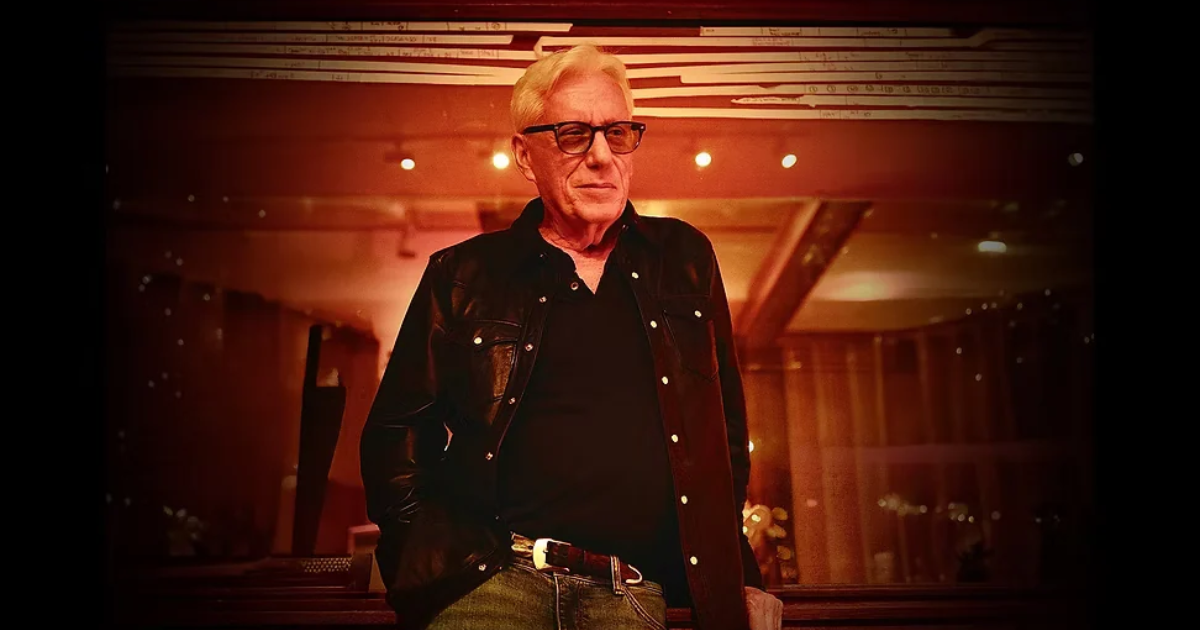
James Woods has spent much of his career bringing other people’s stories to life.
He’s worked with directors like Martin Scorsese and Oliver Stone, delivering performances that helped establish him as one of Hollywood’s most recognizable actors.
But these days, Woods is discovering something different.
He’s writing the stories himself.
Not screenplays.
Not a Hollywood memoir.
Songs.
Dark, cinematic, emotionally complicated songs filled with troubled characters, lost loves, dangerous encounters and questions that don’t always have comfortable answers.
And he’s doing it with a group of musicians who have become considerably more than studio collaborators.
They’ve become friends.
At the center of his musical world is Shooter Jennings, the Grammy-winning producer and musician who helped transform Woods’ lyrics into his first album, Hear the Thunder Crack.
Then there’s Bob Wayne, the singer-songwriter Woods initially knew as a truck-driving musician and eventually discovered was, in his words, a musical savant.
Together, they’ve created three albums.
Hear the Thunder Crack.
Tombstone Opera.
And the latest, The Killer’s Wife.
More music is already on the way.
Woods told me he’s written more than 75 songs, with 30 released across those first three albums and another 13 recently recorded for the next project.
That’s an impressive amount of material for someone whose public identity has been defined by an entirely different creative profession.
But perhaps the most interesting thing about James Woods’ music isn’t how much he’s writing.
It’s why.
Because after decades interpreting the words of other writers, Woods has discovered the freedom of finally expressing the stories that have been living inside him.
And judging by the enthusiasm he brought to our conversation, he has no intention of slowing down.
The Difference Between Acting and Songwriting
I began by asking Woods what his career in film had taught him about making music.
His answer took us somewhere interesting.
He didn’t immediately focus on the similarities.
He focused on the differences.
As an actor, Woods explained, he has spent his career interpreting material created by other people.
A screenwriter develops the story.
A director establishes the vision.
The actor brings the character to life.
That doesn’t mean the actor has no creative freedom.
Quite the opposite.
Woods recalled working with directors such as Oliver Stone and Martin Scorsese, who encouraged him to improvise.
He would always deliver the scripted performance first.
Then, when appropriate, he’d experiment.
Try something different.
Find another way into the scene.
Sometimes the directors used those improvised moments.
But even then, Woods understood that he was interpreting someone else’s original work.
Songwriting has given him something different.
Ownership of the story.
Every lyric.
Every character.
Every concept.
The words originate with him.
Then he hands them to musicians who transform those words into something he couldn’t have created alone.
For someone who has spent a lifetime collaborating with extraordinary filmmakers, it’s a fascinating reversal.
Instead of interpreting the story, Woods is now the person creating it.
The Magic Box
Woods has a wonderfully simple description of his songwriting process.
He writes the lyrics.
Then he puts them into what he calls his magic box.
On the other side of that box is Shooter Jennings.
Or Bob Wayne.
Woods supplies the words.
They supply the music.
The results can surprise even him.
For Hear the Thunder Crack, Jennings handled the compositions.
On Tombstone Opera and The Killer’s Wife, Bob Wayne became a central musical collaborator at Jennings’ suggestion.
Woods initially wasn’t sure what to make of the idea.
He knew Wayne as a musician with a truck-driving background.
Jennings assured him that Wayne was extraordinarily talented.
The two met.
Started working.
And almost immediately developed a creative connection.
That relationship has become one of the most important parts of Woods’ musical career.
Because Woods doesn’t approach the collaboration as someone who needs to control every detail.
He understands the value of giving talented people room to create.
And that philosophy came directly from his experiences in Hollywood.
Give the Artist Room to Work
Woods told me about watching Jennings work with musicians in the studio.
Rather than dictating every note, Jennings would offer suggestions.
Try that again.
Approach it differently.
See what happens.
Simple direction.
But effective.
Woods compared the approach to the relaxed authority of Clint Eastwood.
The idea isn’t to overwhelm the musician with instructions.
It’s to create an environment where the musician can discover something.
Woods eventually applied that philosophy to his relationship with Wayne.
Early in their collaboration, Wayne sent him a musical arrangement he wasn’t particularly happy with.
Wayne was nervous.
He didn’t think he’d gotten it right.
Woods could have rejected it.
Instead, he asked a question.
What would happen if you tried the opposite approach?
Wayne went back to work.
The next version was exactly what the song needed.
That exchange established something important.
Woods wasn’t interested in winning creative arguments.
He wanted the best possible song.
And he understood that sometimes the most useful thing a collaborator can do is ask the right question.
A Waltz Nobody Expected
One of Woods’ favorite examples comes from Tombstone Opera.
The song is called “Nowhere Hill.”
It’s a haunting story about a man visiting a graveyard and singing to a lost love.
The character’s existence is deliberately uncertain.
Is he alive?
Is he a ghost?
The song doesn’t necessarily answer the question.
Instead, it creates an atmosphere of grief, memory and longing.
Woods had written the lyrics with a particular feeling in mind.
Then Wayne returned with the music.
A waltz.
Three-quarter time.
Woods hadn’t anticipated that.
But when he heard the arrangement, he was overwhelmed.
The music transformed the story.
The unfamiliar rhythmic approach gave the lyrics an emotional quality he hadn’t imagined.
And that became one of the central lessons of his songwriting partnership.
Sometimes the composer hears something the lyricist doesn’t.
That’s not a problem.
That’s the reason to collaborate.
The Emotional Pull of Three-Quarter Time
That led us into a conversation about time signatures.
As someone who has spent decades in recording studios, I’ve always appreciated the emotional difference between common time and meters like 3/4 or 6/8.
Most popular music lives comfortably in 4/4.
There’s a familiarity to it.
A predictability.
A pulse listeners understand instinctively.
Change the meter, and the emotional landscape can shift.
A waltz can create a sense of movement that feels more intimate.
More reflective.
Sometimes almost suspended.
Woods brought up John Prine’s “Angel from Montgomery” and the way Prine’s phrasing plays with rhythmic expectations.
He admired how Prine allowed the natural expression of the lyric to influence the musical structure.
That’s an important point.
Great songwriting doesn’t always follow the rules because the rules say it should.
Sometimes a phrase needs an extra beat.
Sometimes the melody needs to breathe.
Sometimes the emotion matters more than the mathematics.
And when the musicians understand that, the results can be extraordinary.
The Story Comes First. Except When It Doesn’t.
I asked Woods whether he begins with a complete story and then writes lyrics around it.
His answer was essentially yes.
And no.
Sometimes he knows exactly what he wants to write about.
Other times, a single phrase begins the process.
A line.
An image.
A thought that won’t leave him alone.
One song, “The Hearts of Men,” grew from a biblical passage in Matthew 24.
The idea of people’s hearts growing cold in a world increasingly shaped by wrongdoing became the foundation of the lyric.
Another song began with something considerably less dramatic.
A street sign.
Bob Wayne mentioned driving past a road called Harm’s Way.
Woods immediately recognized the possibilities.
He told Wayne not to say another word.
Then began writing.
The title suggested a location.
The location suggested a mood.
The mood suggested a character.
And suddenly there was a story.
That’s how songwriting works sometimes.
You can spend hours trying to manufacture an idea.
Then somebody mentions a street sign and the entire song appears.
The Parking Lot Song
One of Woods’ favorite songs on The Killer’s Wife is “Shadows of the Past.”
He wrote it while sitting in a parking lot.
His wife was shopping.
Woods was waiting in the car.
And apparently, inspiration decided the moment was appropriate.
He joked that his wife doesn’t particularly enjoy taking him shopping because he has a tendency to become distracted by unnecessary purchases.
Especially food.
Shopping while hungry is dangerous territory.
I suspect most husbands understand that particular problem.
But on this occasion, the distraction wasn’t a questionable grocery purchase.
It was a song.
The idea arrived.
The words followed.
And “Shadows of the Past” became part of the album.
It’s a useful reminder that creativity doesn’t operate according to a convenient schedule.
Sometimes the studio is the perfect environment.
Sometimes the best idea of the day arrives while you’re waiting for somebody to finish shopping.
The trick is recognizing it when it happens.
The Real Incident Behind The Killer’s Wife
The title track of Woods’ latest album has a particularly unsettling origin.
Woods explained that the song was inspired by a real experience from his life.
Years ago, he knew a young woman whose husband was a serial killer.
The song itself is fictional.
But the question that inspired it was real.
Why hadn’t the husband killed her?
That question stayed with Woods.
What did she know?
What didn’t she know?
What was happening inside that marriage?
How could someone live alongside a person capable of such violence?
And what does it mean to love someone whose actions are almost impossible to comprehend?
Those questions became the foundation for the fictional story.
That’s what makes Woods’ songwriting particularly interesting.
He’s drawn to complicated human situations.
Not necessarily stories with obvious heroes and villains.
But stories where the emotional truth is more difficult to understand.
And where the most important question may never receive a complete answer.
Why Concept Albums Still Matter
As Woods and his collaborators began accumulating songs, something unexpected happened.
The albums started revealing larger themes.
Not because Woods had necessarily planned every detail in advance.
But because the individual stories began connecting.
He realized he was creating concept albums.
And he loves that.
Woods spoke enthusiastically about records that function as complete artistic statements.
Bruce Springsteen’s Nebraska.
The work of Bob Dylan.
Paul Simon.
Pink Floyd.
Albums that offer more than a collection of unrelated songs.
They establish a world.
A perspective.
Sometimes a narrative.
Sometimes simply a consistent emotional atmosphere.
That’s increasingly unusual in an industry built around singles, playlists and short attention spans.
But Woods isn’t particularly interested in chasing those trends.
He wants listeners to experience the albums as complete works.
And he wants the songs to belong together.
The Road Back
The first album provides a perfect example.
Woods and Jennings believed they’d finished recording Hear the Thunder Crack.
The songs were there.
The project felt complete.
Except Woods sensed something was missing.
Jennings pointed out that the songs were essentially autobiographical.
Stories connected to Woods’ own life.
Roads.
Experiences.
Memories.
Moments that had shaped him.
Woods hadn’t consciously recognized that theme.
But once Jennings mentioned it, the connection became obvious.
They began considering The Road Back as a possible album title.
There was only one problem.
They didn’t have a song called “The Road Back.”
So Woods wrote one.
That night.
Jennings composed the music the following day.
And within approximately a week, the album had gained an important new song.
But the title still wasn’t quite right.
Another memory provided the answer.
A Tornado in the Night
Woods recalled driving across the country with his small dog.
During the journey, he encountered a tornado at night.
The experience was terrifying.
Lightning illuminated the sky.
Thunder cracked.
And Woods could see the funnel.
For a moment, he genuinely believed he might die.
That memory became part of the emotional foundation for “The Road Back.”
And it eventually inspired the album’s title.
Hear the Thunder Crack.
It’s a powerful image.
The kind that works particularly well in songwriting because it operates on more than one level.
Literally, it’s the sound of a violent storm.
Emotionally, it’s the moment when life becomes uncertain.
When the world feels dangerous.
When you’re forced to confront something beyond your control.
That’s the kind of imagery Woods enjoys.
Specific enough to create a vivid picture.
Broad enough to connect with experiences beyond his own.
The Album That Builds Itself
Woods told me something interesting about the way his albums develop.
They rarely begin with a rigid concept.
Instead, the songs accumulate.
A few ideas appear.
Then another.
Eventually Woods notices a relationship between them.
A recurring image.
A shared emotional concern.
A question that keeps appearing in different forms.
That’s when the album begins revealing its identity.
He doesn’t want to force it.
He doesn’t sit down and announce that the next record will be about a particular historical event simply because it sounds like an interesting concept.
The material has to emerge naturally.
That’s an important distinction.
A concept album can become painfully artificial when the concept matters more than the songs.
Woods wants the opposite.
Songs strong enough to stand alone.
But connected enough to create something larger when heard together.
A Moment of Silence Underground
One of the most moving stories Woods shared involved John Lennon.
After Lennon’s death, Woods was traveling toward Central Park for a moment of silence.
The event drew an enormous crowd.
Woods remembered being on a subway train that became delayed.
The passengers were frustrated.
They were trying to reach the gathering.
Then the train operator made an announcement.
He understood where everyone was going.
And suggested they observe the moment of silence right there.
On the train.
Underground.
In the darkness.
Woods remembered passengers holding hands.
Strangers sharing a moment of grief.
An entire subway car becoming part of a collective act of remembrance.
The image stayed with him for decades.
Eventually he wrote a song about it.
Bob Wayne composed the music.
And the result became one of the emotional foundations for another album project.
What makes that story powerful isn’t simply the connection to Lennon.
It’s the humanity.
People who didn’t know one another sharing a moment of loss.
A city briefly becoming quiet.
A songwriter remembering that experience years later and finding a way to preserve it.
That’s the kind of material Woods wants to explore.
When a Song Is Bigger Than One Event
Woods also discussed a song intended for a future album.
The material addresses the murder of people whose beliefs, ideas or public influence made them targets.
He mentioned figures including John Lennon, Martin Luther King Jr., Medgar Evers, John F. Kennedy and Joan of Arc, alongside a more recent political assassination.
The song was written around the time of that recent event.
Woods and Jennings decided not to release it immediately.
Their concern was that listeners might interpret it as a reaction to one particular incident rather than the broader subject Woods wanted to explore.
For Woods, the song wasn’t intended as a statement about one person.
It was about the recurring tragedy of violence directed at people because of what they believed or represented.
That decision illustrates something important about his approach.
He’s thinking beyond the immediate moment.
He wants the song to remain meaningful after the headlines change.
And sometimes that means waiting.
Even when the material is finished.
Inside the Studio With Shooter Jennings
Eventually, the conversation turned toward the recording process.
This is where my ears naturally perk up.
Because there’s a significant difference between writing songs and turning them into records.
Woods works with an impressive group of musicians.
And he approaches the sessions in a way I found particularly interesting.
Before recording, he and his wife, Sarah, prepare printed copies of the lyrics.
A lot of copies.
Woods joked about printing hundreds.
Then he distributes them to the musicians.
He explains what inspired the songs.
What the characters are experiencing.
What he was thinking when he wrote the lyrics.
The musicians listen to the demos.
Make their charts.
And begin developing the arrangements.
Woods initially wondered whether providing so much background was useful.
Fiddler Aubrey Richmond assured him that it was.
Understanding the story helped the musicians understand what they were trying to communicate.
That’s a smart approach.
Because great musicians aren’t simply playing notes.
They’re interpreting emotion.
And the more they understand about the song, the more effectively they can contribute to it.
The First Take
Woods remains amazed by how quickly the musicians work.
They hear a song.
Listen to the demo.
Make their charts.
And play.
Sometimes the first performance is already remarkably close to what the record needs.
That astonished him during the early sessions.
It doesn’t surprise me quite as much.
I’ve spent years watching Nashville session musicians do exactly that.
It’s one of the extraordinary things about working with players at that level.
They don’t need days to learn a relatively straightforward arrangement.
They listen.
Understand the structure.
Find the feel.
And begin making musical decisions almost immediately.
The technical skill is impressive.
But the real magic is musical judgment.
Knowing what not to play.
Understanding where the lyric needs space.
Recognizing when a small change in dynamics can transform the emotional impact.
Those are the qualities that separate excellent musicians from people who can simply play difficult parts.
Two Words Can Change a Song
Woods shared a story about one of the first recording sessions.
They were working on “Cafe Central.”
Jennings offered the band a simple reference.
Think Joy Division.
That was it.
No lengthy explanation.
No elaborate production meeting.
Just a musical direction that immediately suggested a particular atmosphere.
The musicians understood.
And the arrangement moved toward that sound.
Another session produced an even more emotional moment.
Jennings turned to Richmond and suggested she think about the Civil War.
The resulting fiddle performance was devastating.
Woods compared the feeling to the emotional landscape of Cold Mountain.
Loss.
Defeat.
Grief.
The weight of history.
He described the room becoming emotional as Richmond played.
That’s the power of working with musicians who understand storytelling.
A producer can spend an hour describing the desired sound.
Or offer two words that immediately unlock the emotional center of the song.
When the musicians are that good, the right suggestion can change everything.
The Players Who Make It Happen
Woods was enthusiastic about the musicians who contribute to his records.
Aubrey Richmond on fiddle.
Ted Russell Kamp.
John Schreffler Jr.
The Waters providing backing vocals.
And drummer Jamie Douglass, among others.
He appreciates their technical ability.
But what seems to matter even more is their commitment.
These aren’t simply musicians arriving to complete another session.
They’ve become invested in the project.
They understand the stories.
They look forward to making the records.
Woods recalled one musician telling him that he waits all year for the next album session.
That meant a great deal to him.
And I understand why.
There’s something special about a recording environment where everybody genuinely wants to be there.
The musicians aren’t watching the clock.
They’re engaged.
They’re contributing.
They’re excited to hear what the songs become.
That kind of energy is difficult to manufacture.
And it usually finds its way onto the recording.
Thirteen Rocks in a Garden
Woods is already thinking about the next album.
He was careful not to reveal too much.
But he did offer an intriguing description.
The project contains 13 songs.
And unlike the more narrative-driven albums, this one doesn’t necessarily follow a traditional dramatic structure.
Instead, Woods compared it to a Japanese rock garden.
Thirteen stones.
Each different.
Each possessing its own character.
But arranged within a larger environment that gives them a shared identity.
He also referenced the Beatles’ White Album.
Not as a claim that his own work belongs in the same category.
He was quick to express his admiration for the Beatles.
But as an example of an album where individual songs can be dramatically different while still belonging to a recognizable whole.
That’s an interesting direction.
It suggests Woods is becoming increasingly comfortable allowing the material to determine the form.
Not every album needs a conventional narrative.
Sometimes the connection is thematic.
Emotional.
Spiritual.
Or simply the result of one songwriter’s perspective appearing across different stories.
The Vinyl Experience
Woods is also enthusiastic about the physical presentation of his music.
He mentioned the vinyl editions produced through Memphis Record Pressing.
Each one, he explained, has a handmade quality.
And he clearly enjoys the idea of listeners owning a tangible version of the work.
That’s refreshing.
Not because streaming is inherently bad.
It has made music accessible in ways previous generations couldn’t have imagined.
But a physical album encourages a different relationship with the material.
You hold it.
Look at the artwork.
Read the information.
Put the record on.
And ideally, listen to the entire thing.
For someone creating concept albums, that matters.
The sequencing matters.
The relationship between songs matters.
And the listener’s willingness to spend time with the complete work becomes part of the experience.
Woods isn’t simply releasing individual tracks.
He’s building albums meant to be experienced.
The Promise
Near the end of our conversation, I asked Woods about his unsung hero.
The person who had supported him along the way.
Someone whose contribution might not receive the recognition it deserves.
He didn’t hesitate.
His mother.
Martha.
And the story he told was one of the most meaningful moments of our conversation.
Woods was 21 years old.
He was attending MIT on a full scholarship.
He was doing extremely well academically.
And he had reached a decision.
He wanted to leave school.
Move to New York.
Become an actor.
That’s a fairly significant change in career direction.
Especially when you’re attending one of the most prestigious technical universities in the world.
So he called his mother.
And told her what he wanted to do.
A Mother Who Understood Risk
Martha didn’t respond by telling him he was making a mistake.
She told him a story.
She had married Woods’ father when she was 19.
People told her she was too young.
They questioned the decision.
But she believed it was the greatest choice she’d ever made.
Her husband was a remarkable man.
Then he died.
James was only 12.
His younger brother was three.
Martha was devastated.
And suddenly she had to find a way to support her family.
She took what little money she had and started a nursery school.
Over time, it became a successful operation.
She ran it for 28 years.
The school served approximately 105 children each year.
She employed seven people.
And the children even performed a play in French when they graduated.
Woods recalled how people still recognize him because they attended his mother’s school.
They remember Miss Martha.
They remember what she meant to them.
And Woods remembers what she meant to him.
Do Your Best Every Day
After telling him her story, Martha gave her son an answer.
If he wanted to leave MIT and pursue acting, he should do it.
She would support him.
Completely.
But there was one condition.
He had to make her a promise.
Whether he succeeded or failed, he would do his very best every single day.
Not simply when things were going well.
Not when success seemed guaranteed.
Every day.
Woods made the promise.
And during our conversation, he told me he has never broken it.
That’s a powerful statement.
Because it changes the definition of success.
His mother didn’t demand that he become famous.
She didn’t insist he earn a particular amount of money.
She didn’t require him to win awards.
She asked for effort.
Commitment.
Integrity.
And the willingness to take responsibility for the opportunity he’d chosen.
Woods credits that promise with making his career possible.
Not just his acting career.
Everything.
The Hero Behind the Career
There’s something particularly meaningful about Woods choosing his mother as his unsung hero.
He’s worked with extraordinary directors.
Famous actors.
Accomplished musicians.
And some of the most respected creative professionals in entertainment.
He could have named almost anyone.
But when asked who made the difference, he returned to the person who believed in him before the career existed.
The woman who had already experienced tremendous loss.
Who rebuilt her own life.
Who created something meaningful for hundreds of children.
And who understood that the greatest gift she could give her son wasn’t certainty.
It was permission to try.
With one condition.
Do your best.
Every day.
That’s the kind of advice that survives changes in career, industry and circumstance.
And it explains something about Woods’ enthusiasm for music.
He’s not approaching songwriting as a casual hobby.
He’s approaching it with the same commitment he brought to acting.
The same desire to work with excellent people.
The same willingness to explore difficult material.
And the same belief that creativity requires both freedom and discipline.
The Next Act
It’s tempting to describe James Woods’ music as a second career.
But after our conversation, I’m not sure that’s entirely accurate.
The creative instincts seem remarkably consistent.
He’s always been interested in stories.
Characters.
Conflict.
Emotion.
And the complicated decisions people make when life becomes difficult.
As an actor, he explored those subjects through performances.
Now he’s exploring them through lyrics.
The medium has changed.
The curiosity hasn’t.
And perhaps that’s why the songs seem to arrive so naturally.
Woods has spent decades observing people.
Studying human behavior.
Interpreting stories.
And working with some of the most talented storytellers in entertainment.
Now all those experiences are finding their way into his own writing.
Sometimes through a memory.
Sometimes through a biblical passage.
Sometimes through a frightening encounter with a tornado.
And sometimes through a street sign somebody happened to notice while driving.
The material is everywhere.
He simply has to recognize it.
The Stories Still Waiting
When we finished our conversation, Woods was already looking ahead.
Another album had been recorded.
More songs were written.
More ideas were developing.
And his enthusiasm was unmistakable.
He spoke about his collaborators with genuine affection.
About the recording process with excitement.
About his lyrics with pride.
And about his mother with a depth of gratitude that made the entire conversation feel different.
Because ultimately, this wasn’t simply an interview about an actor making records.
It was a conversation about creativity.
About trusting talented people.
About understanding that a song can become something greater when you allow others to contribute.
About recognizing the emotional power of a story.
And about honoring a promise made decades ago.
James Woods has spent much of his life telling stories written by other people.
Now he’s writing his own.
And with more than 75 songs already on paper, there’s clearly plenty left to say.
But I suspect the most important words in his creative life aren’t lyrics from The Killer’s Wife.
Or Tombstone Opera.
Or Hear the Thunder Crack.
They’re the words his mother gave him when he was 21 years old and preparing to take the biggest risk of his life.
Do your best.
Every day.
He promised he would.
And all these years later, he’s still keeping that promise.